Thu, April 16, 2026

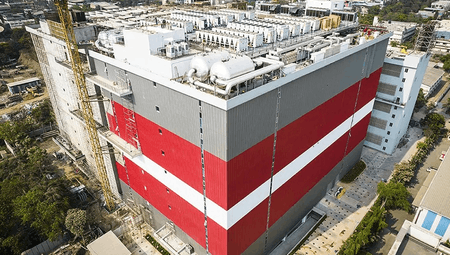
India’s data centre industry is on a steep growth curve, with its market size projected to more than double from $10 billion in 2025 to $22 billion by 2030, reflecting strong investor confidence and rapid digital expansion.
According to a recent report by Vestian, India is fast emerging as a strategic data centre hub in the Asia-Pacific region, driven by rising internet usage, digital transformation across industries, and increasing investments from global hyperscale players.
Rapid Capacity Expansion Backed by Investments
The country’s installed data centre capacity is expected to reach 1.7–2.0 GW by 2026, supported by nearly $30 billion in investments. This capacity is projected to further scale up to 4–5 GW by 2030, highlighting sustained long-term growth.
Between 2020 and 2024 alone, the sector attracted $13–15 billion in investments, with foreign institutional investors contributing nearly 80% of total inflows. Looking ahead, the pipeline remains robust, with $60–70 billion worth of projects planned over the next five years.
Policy Push and Cost Advantage Fuel Growth
India’s policy ecosystem is playing a crucial role in accelerating growth. Measures such as single-window clearances, long-term tax incentives, GST benefits, and government support extending up to 2047 are making the country increasingly attractive for global investors.
Additionally, India offers a significant cost advantage, with data centre construction costs estimated at $6–7 million per MW, much lower than established APAC markets like Singapore and Japan. This positions India as a preferred destination for large-scale infrastructure investments.
As noted by Shrinivas Rao, the sector is rapidly evolving and holds strong potential to become a global hub for AI and data infrastructure.
Key Data Centre Hubs Across India
India’s data centre ecosystem is currently concentrated in major metropolitan regions:
Mumbai – The largest hub, benefiting from strong global connectivity and infrastructure
Chennai – A critical data gateway with multiple submarine cable landings
Hyderabad, Bengaluru, and Pune – Emerging as major secondary hubs due to strong IT ecosystems and cost advantages
Meanwhile, tier-2 cities like Ahmedabad, Kochi, Jaipur, and Visakhapatnam are gaining traction thanks to improving infrastructure and supportive policies.
Operational capacity in these smaller markets is currently around 60–80 MW and is expected to cross 100 MW by 2026.
A Promising Digital Future
With a rapidly expanding digital economy, favourable government policies, and competitive costs, India is well-positioned to become a global leader in data centres and AI infrastructure in the coming decade.
With inputs from IANS




| 14-09-2018 | ||||||
| Sl No. | Parameters | Actual Data(µg/m3) | Standard Limit(µg/m3) |
|---|---|---|---|
| 1 | PM 10 | 64 | 100 |
| 2 | PM 2.5 | 33 | 60 |
| 3 | SO2 | 55.3 | 80 |
| 4 | NO2 | 58.2 | 80 |
| 14-09-2018 | ||||||
| Station | Temperature(degree centigrade) | Rainfall(mm) | Relative humidity(%) | |||
|---|---|---|---|---|---|---|
| Max | Min | Past 24 hrs. | Since 1st March, 2018 | Max | Min | |
| Ranchi | 31.0 | 22.5 | 000.0 | 1010.1 | 95 | 66 |
| Jamshedpur | 34.1 | 26.2 | 000.0 | 1252.8 | 87 | 58 |
| Bokaro | 33.5 | 24.6 | 015.2 | 824.0 | 92 | 79 |
| Daltonganj | 32.6 | 24.9 | 004.2 | 960.9 | 95 | 67 |
© Copyright
Reporter Post.All Rights Reserved |
Powered by: Aptilogic Software |
 |
Page rendered in 0.0855 seconds.
|
Page rendered in 0.0855 seconds.