Thu, April 16, 2026

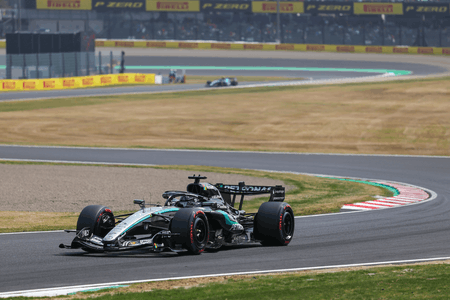
Just three races into the 2026 Formula 1 season, Mercedes-AMG Petronas Formula One Team has emerged as the team to beat—but with success has come an unexpected internal challenge. Both George Russell and rookie sensation Kimi Antonelli are performing at a level where neither can be clearly defined as the outright lead driver.
The season began in Australia with Russell delivering a textbook performance, converting pole position into a commanding win, while Antonelli followed closely behind to complete a strong one-two finish for Mercedes. At that stage, the hierarchy seemed clear—but it didn’t stay that way for long.
In China, Russell once again demonstrated his pace by securing sprint pole and victory. However, the spotlight shifted in the main race, where Antonelli claimed both pole position and his maiden Grand Prix win, showing remarkable composure and control at the front. Although Russell recovered from a qualifying setback to finish second, the momentum had clearly begun to tilt.
Antonelli builds momentum
Antonelli has remained grounded despite his rapid rise, emphasizing consistency over early celebration. Speaking in Shanghai, he acknowledged the long season ahead and the need to stay focused.
That approach paid off again in Suzuka. Antonelli secured another pole and, despite losing positions at the start, capitalized on a well-timed Safety Car to regain track position. Once back in front, he controlled the race with growing authority. Meanwhile, Russell found himself on the wrong side of race circumstances and could only manage fourth.
Across the opening rounds, Antonelli has turned opportunities into victories and now leads the championship. While the points gap remains tight, the psychological edge appears to be shifting in his favour.
Russell stays composed
For Russell, the response has been measured and consistent. He insists his approach remains unchanged—focused purely on extracting maximum performance every time he gets in the car.
Despite proving his speed with a win in Australia and strong pace in China, recent races have seen Antonelli capitalize more effectively on key moments. This puts Russell in an unusual position: fast enough to compete, but needing stronger execution to reclaim momentum.
He also highlighted how closely matched the field has become, noting that even tiny differences in lap time now result in teammates lining up side by side rather than being separated across the grid.
A familiar Mercedes dilemma
Team principal Toto Wolff will recognize the situation all too well. Mercedes has previously navigated intense intra-team rivalries, most notably between Lewis Hamilton and Nico Rosberg, where close competition eventually led to friction.
While Russell has been quick to point out that his dynamic with Antonelli is different—given their differing career stages and lack of shared history—the underlying challenge remains. When two drivers are evenly matched in a competitive car, tension is almost inevitable over time.
Focus vs expectation
Antonelli, for now, appears insulated from that pressure. His mindset remains centered on adapting to the car and maximizing performance rather than thinking about the championship battle. That clarity has helped him build momentum without distraction.
Russell, on the other hand, carries the weight of expectation as the more experienced driver—someone expected to lead the team and set the benchmark.
An untimely break
An unusual five-week gap in the calendar—caused by cancelled races in Bahrain and Saudi Arabia—has frozen the narrative at a delicate moment. Instead of a quick chance to respond, Russell must wait until the next race in Miami to shift the momentum.
For now, the championship fight remains wide open. But one thing has already changed: what started as a straightforward campaign for Mercedes has quickly evolved into a compelling intra-team battle—raising an early-season question few expected so soon: how does the established driver respond when the rising star starts to take control?
With inputs from IANS




| 14-09-2018 | ||||||
| Sl No. | Parameters | Actual Data(µg/m3) | Standard Limit(µg/m3) |
|---|---|---|---|
| 1 | PM 10 | 64 | 100 |
| 2 | PM 2.5 | 33 | 60 |
| 3 | SO2 | 55.3 | 80 |
| 4 | NO2 | 58.2 | 80 |
| 14-09-2018 | ||||||
| Station | Temperature(degree centigrade) | Rainfall(mm) | Relative humidity(%) | |||
|---|---|---|---|---|---|---|
| Max | Min | Past 24 hrs. | Since 1st March, 2018 | Max | Min | |
| Ranchi | 31.0 | 22.5 | 000.0 | 1010.1 | 95 | 66 |
| Jamshedpur | 34.1 | 26.2 | 000.0 | 1252.8 | 87 | 58 |
| Bokaro | 33.5 | 24.6 | 015.2 | 824.0 | 92 | 79 |
| Daltonganj | 32.6 | 24.9 | 004.2 | 960.9 | 95 | 67 |
© Copyright
Reporter Post.All Rights Reserved |
Powered by: Aptilogic Software |
 |
Page rendered in 0.0514 seconds.
|
Page rendered in 0.0514 seconds.