Mon, September 28, 2026

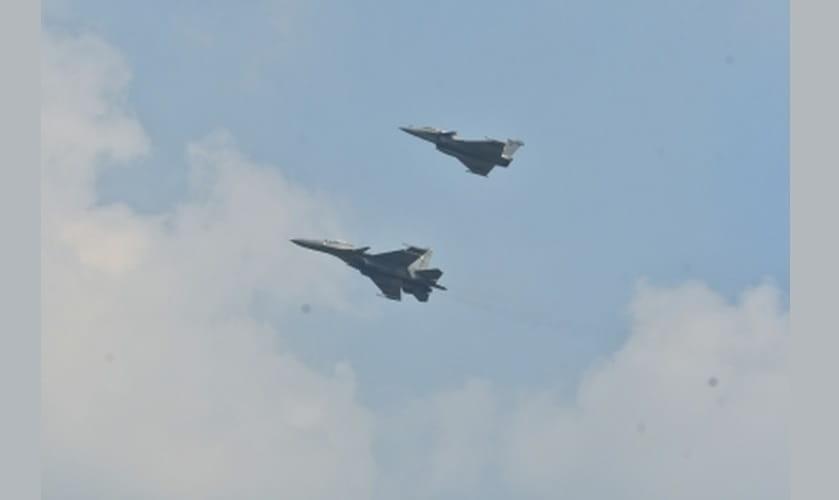
Photo: IANS
India’s planned procurement of additional Rafale fighter jets from France is expected to help establish a second fighter aircraft production line in the country, while also increasing the scope for indigenous defence manufacturing, Defence Secretary Rajesh Kumar Singh said on Sunday.
Speaking at the NDTV Defence Summit 2026, Singh said France had agreed to India’s requirement that the Rafale aircraft be manufactured in India with significant levels of indigenisation. He said this would allow the country to expand its fighter aircraft manufacturing capacity.
“Rafale is a proven aircraft. France has agreed to our mandate that they make it in India with significant levels of indigenisation. It enables us to create a second production line for fighter aircraft in the country,” Singh said.
The Defence Secretary, who also holds additional charge as Secretary of the Department of Defence Research and Development and Chairman of the Defence Research and Development Organisation (DRDO), made it clear that the Rafale procurement would run alongside India’s indigenous fighter programme.
He said the Light Combat Aircraft (LCA) Tejas Mark 1A programme, led by Hindustan Aeronautics Limited (HAL), would continue independently. According to Singh, the Tejas programme will follow a “spiral development” approach, with successive improvements including indigenous radars and weapons.
The comments underline a two-track approach to strengthening India’s fighter fleet: expanding near-term combat aircraft capacity through additional Rafale procurement while continuing the development and production of indigenous Tejas fighters.
Singh also provided an update on the broader capability requirements of the Indian Air Force. He said three major areas had been identified as concerns when he first came to the Defence Ministry — the declining size of the fighter fleet and shortages involving force multipliers such as airborne early warning and control (AEW&C) aircraft and aerial refuellers.
According to Singh, steps are now underway to address all three gaps. He said the process would take time, but once contracts are signed, delivery schedules would provide greater clarity on when the required capabilities would enter service.
The Defence Secretary also indicated that Tejas Mark 1A production is progressing. The Times of India reported that he said HAL had 27 airframes ready and that additional GE engines were expected to support deliveries, with one Tejas Mark 1A squadron targeted for induction by the end of 2026.
The Rafale proposal is therefore not being presented by the Defence Ministry as a replacement for Tejas, but as an additional production and capability pathway. The proposed manufacturing arrangement would also give India another fighter-aircraft production line while increasing the level of local manufacturing associated with the Rafale programme.
The remarks came as the government continues efforts to expand domestic defence production, strengthen military capabilities and reduce dependence on imported defence equipment through greater technology development and indigenisation.
The NDTV Defence Summit 2026, held under the theme “India’s New Defence Edge”, brought together senior defence officials, military leaders and industry representatives to discuss fighter aircraft, emerging technologies, indigenous manufacturing and the changing requirements of India’s armed forces.



© Copyright
Reporter Post.All Rights Reserved |
Powered by: Aptilogic Software |
 |
Page rendered in 0.0149 seconds.
|
Page rendered in 0.0149 seconds.