Tue, October 13, 2026

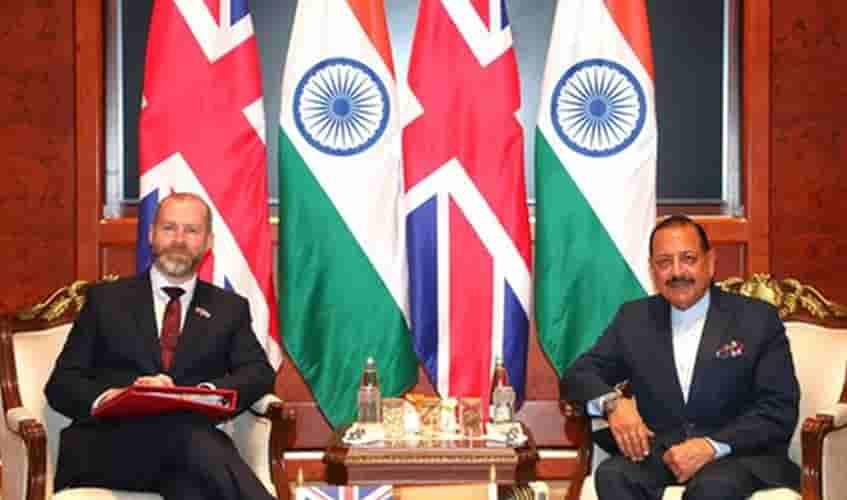
Photo: IANS
India and the United Kingdom are exploring new avenues for cooperation in space technology, civil nuclear energy, scientific research and emerging technologies, as both countries look to strengthen research partnerships and expand opportunities for industry.
Union Minister of State Dr Jitendra Singh held bilateral discussions on Monday with Jonathan Reynolds, the UK's Secretary of State for Business, Innovation, Science and Trade, focusing on areas where the two countries can combine their scientific expertise and industrial capabilities.
According to the Ministry of Science and Technology, the Indian delegation was led by Singh and included Department of Science and Technology (DST) Secretary Prof. Umesh Waghmare and Dr Praveenkumar Somasundaram, Adviser and Head of International Bilateral Cooperation at the department.
The UK delegation included Reynolds, British High Commissioner to India Lindy Cameron and Amanda Brooks, Interim Permanent Secretary of the Department for Business, Innovation, Science and Trade.
Space technology emerged as a key area of discussion, with Singh highlighting how India's space-sector reforms have created greater opportunities for private companies and startups while allowing research institutions to concentrate on advanced scientific work.
He said India and the UK could build on this experience by expanding joint research, encouraging industry participation and strengthening links between scientific institutions and technology businesses.
The discussions also covered space science, satellite development and closer collaboration between research organisations and commercial enterprises. With around 800 space-tech startups in India, Singh proposed stronger connections between Indian and British startups to encourage innovation, develop new technologies and open up commercial opportunities.
Civil nuclear energy was another important focus. Singh referred to India's nuclear-sector reforms, including the SHANTI Act, 2025, and said the country was creating opportunities for wider participation in the sector, drawing on its experience of opening up the space industry.
Both sides explored potential cooperation in small modular reactors (SMRs), advanced nuclear technologies and related industrial capabilities. The discussions come amid rising energy requirements and the growing power demands of data centres, which have increased interest in developing reliable and advanced energy solutions.
Singh also highlighted the wider applications of India's nuclear programme beyond electricity generation, particularly in nuclear medicine and healthcare. These areas, he noted, could provide opportunities for collaboration with British expertise in life sciences and related research.
Beyond space and nuclear energy, the two delegations discussed artificial intelligence (AI), quantum technologies, cyber-physical systems and cybersecurity. These fields offer further scope for joint research, technology development and closer engagement between institutions and businesses in both countries.
Reynolds welcomed greater engagement between India and the UK, emphasising the potential for regular exchanges between institutions and expanded commercial cooperation.
The discussions reflect a shared interest in translating scientific collaboration into practical applications, with partnerships between startups, research institutions and businesses potentially playing a central role in advancing innovation and creating new opportunities in both countries.



© Copyright
Reporter Post.All Rights Reserved |
Powered by: Aptilogic Software |
 |
Page rendered in 0.0117 seconds.
|
Page rendered in 0.0117 seconds.