Sun, November 22, 2026

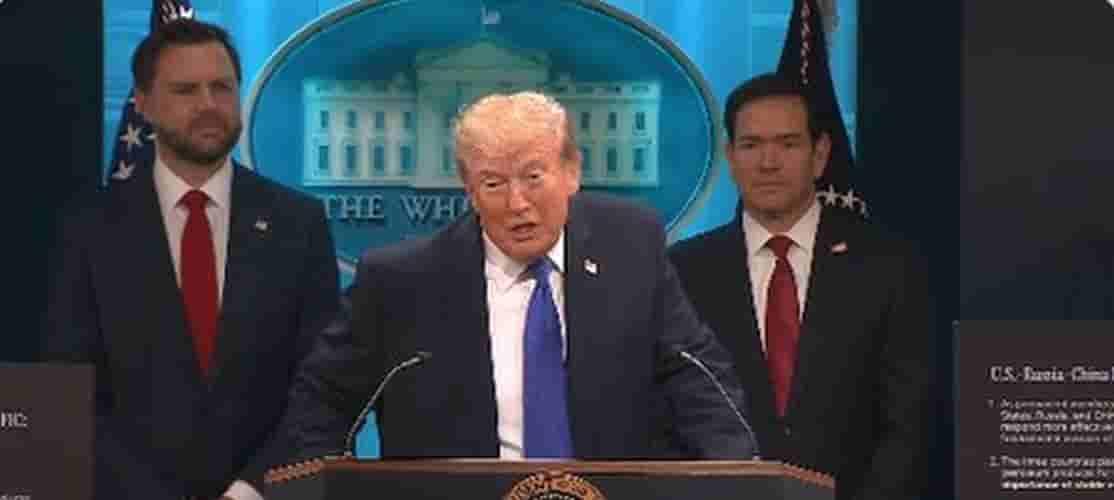
Photo: IANS
Washington: US President Donald Trump has announced a joint artificial intelligence initiative involving India, the United States, Japan and Australia, while making it clear that Washington would restrict its technology-sharing and seek to keep the development of advanced AI systems within American territory.
Speaking on Friday after returning from Asia, Trump said the four leaders had agreed at their Quad summit in Manila, the Philippines, on Tuesday to collaborate on developing what he described as "superintelligence (SI)".
"We launched a new Quad SI Accelerator, aligning our four countries to develop superintelligence," he said, adding that the initiative would advance the shared interests of the four partners.
However, Trump indicated that US participation would have limits and stressed that he wanted the technology to be developed in the United States. He offered no details about how the partners would divide responsibilities or what research and technology Washington would make available.
The US President also announced the proposed first Quad Bureau Leaders Forum, which he said would bring the four countries together on economic security and strengthening supply chains.
The leaders had also agreed to deepen cooperation on maritime security and surveillance, including cybersecurity and the protection of undersea communication cables.
On AI cooperation with China, Trump said he and Chinese President Xi Jinping had agreed to work together on safeguards. Ranking the US first and China second in the development of the technology, he claimed that no other country came close.
He did not provide details of the proposed safeguards, but underlined the strategic importance of the technology, saying, "Whoever wins SI wins."
Trump was more explicit about his plans to discourage American companies from building AI data centres overseas. He warned that companies choosing foreign locations for such projects would face a substantial US tax, citing a proposed project in Finland without identifying the company involved or specifying the tax rate.
He acknowledged that he had not yet discussed the proposal with his staff.
The President also urged communities in the US to negotiate benefits with companies seeking to establish data centres in their areas. Referring to states such as Texas and California, he said companies unable to secure approval for projects there could consider West Virginia or other states keen to attract investment.
Trump said companies could arrange their own power supplies and negotiate payments with host communities. He cited a project in Louisiana where, according to him, teachers were being offered $50,000 to help secure local approval.
He also cautioned that delays in obtaining construction permissions in the US could push companies to establish facilities overseas.
Separately, Trump said the Philippines and Malaysia had agreed to use American technology and services for their cloud infrastructure. He announced the commitments while outlining the outcomes of his discussions with Southeast Asian leaders, without indicating whether the proposed tax on overseas data centres would apply to those agreements.
The Quad, comprising India, the US, Japan and Australia, is a diplomatic partnership focused on cooperation in the Indo-Pacific. Its agenda has expanded from maritime security to include critical and emerging technologies, infrastructure and resilient supply chains. The leaders of the four countries first met as a group in 2021.
Data centres are essential to the development and operation of AI systems, as they house the computing infrastructure required to store and process information. Reliable electricity supply is a key consideration in selecting locations for these energy-intensive facilities, while undersea cables carry data across international networks.



© Copyright
Reporter Post.All Rights Reserved |
Powered by: Aptilogic Software |
 |
Page rendered in 0.0114 seconds.