Sat, November 21, 2026
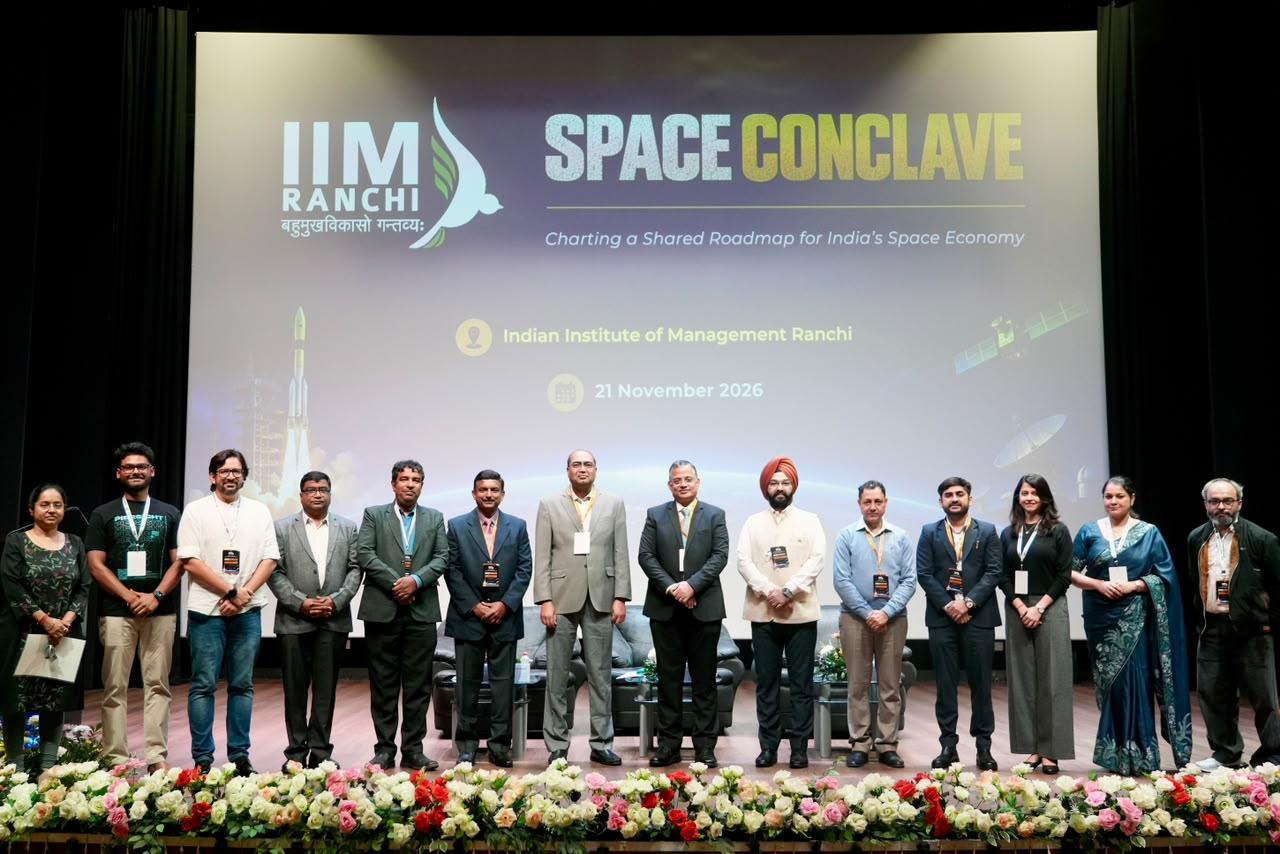
Ranchi: The Indian Institute of Management (IIM) Ranchi hosted the Space Conclave 2026 under the theme “Charting a Shared Roadmap for India’s Space Economy”, focusing on India’s ambitious vision of building a $44 billion space economy under ISRO’s Space Vision 2030. The conclave brought together senior space-sector leaders, academicians, industry experts, startup founders, legal professionals, researchers and students to discuss emerging opportunities, policy reforms and the future of India's commercial space sector.
The event featured a keynote address by Shri Radha Krishna A., Chairman and Managing Director of NewSpace India Limited (NSIL), in the presence of IIM Ranchi Director Prof. Deepak Kumar Srivastava and Conclave Chairperson Prof. Arun Singh Rana.
In his opening address, Prof. Rana traced India's remarkable space journey from its first rocket launch at Thumba, Kerala, in 1963, to its achievements in lunar exploration. Highlighting the growth of the country's space ecosystem, he noted that India's space economy, valued at approximately $8.4 billion, has expanded from just one startup in 2014 to nearly 440 space startups in 2026. He stressed that achieving the $44 billion target by 2033 and increasing India's global market share from 2% to 10% would require close collaboration among government agencies, ISRO, private companies, investors and academic institutions.
Prof. Srivastava highlighted the growing importance of space as a commercial industry and emphasised the role of management education in developing innovative business models. He encouraged students to explore emerging fields such as space marketing, space finance and space economics.
In his keynote address, Shri Radha Krishna A. said India's space economy, currently valued at around $8.5 billion, could reach $44 billion within seven years and $100 billion by 2040. He explained the respective roles of ISRO, IN-SPACe and NSIL in research, regulation and commercialisation. He also pointed out that 85–90% of the sector's opportunities lie in downstream services, including agriculture, banking and weather forecasting, rather than rocket and satellite manufacturing alone. He highlighted the emergence of over 400 startups, government support through a ?1,000 crore fund and the transfer of more than 100 technologies to private companies.
Several panel discussions examined space education, entrepreneurship, industry development and international partnerships. Experts discussed integrating space science into school education under NEP 2020, developing space tourism and awareness initiatives, and emerging career opportunities in space law. A fireside chat titled “The Private Space Revolution” explored the growing role of startups and private enterprises in India's space ecosystem.
Further discussions focused on building India's space economy value chain and strengthening space diplomacy through policy, technology and global partnerships.
The conclave concluded with a call for stronger collaboration between management institutions, scientists, entrepreneurs and industry leaders to translate India's scientific achievements into sustainable commercial opportunities and establish the country as a significant player in the global space economy.



© Copyright
Reporter Post.All Rights Reserved |
Powered by: Aptilogic Software |
 |
Page rendered in 0.0098 seconds.