
Fri, November 20, 2026

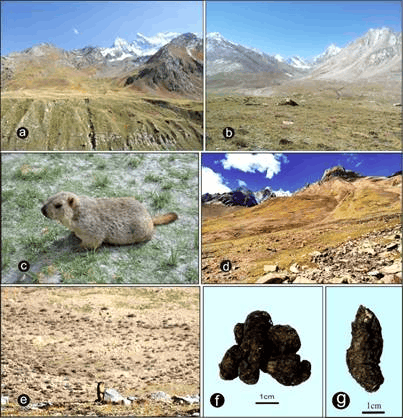
New Delhi: The droppings of Himalayan marmots could offer scientists valuable insights into changing environmental conditions in the higher Himalayas, potentially helping them monitor the impact of climate change on fragile alpine ecosystems, according to a new study.
Researchers at the Birbal Sahni Institute of Palaeosciences (BSIP), an autonomous institute under the Department of Science and Technology, examined pollen grains, fungal spores and elemental signatures preserved in the faeces of Himalayan marmots (Marmota himalayana). These herbivorous mammals inhabit the cold, dry, high-altitude regions of the Himalayan mountains.
The study found that Himalayan marmots could serve as important indicator species for tracking changes in vegetation and climate at higher elevations. Variations in their habitats may also provide evidence of shifts in altitude associated with changing environmental conditions.
According to the Ministry of Science and Technology, the researchers combined pollen analysis, fungal spore identification and elemental examination to establish a modern reference that could support future studies of past ecosystems. The findings, published in the journal PLOS ONE, could help scientists reconstruct historical ecological changes and assess the long-term effects of climate change.
The research also has implications for wildlife conservation. A better understanding of the marmot's habitat requirements could help develop conservation strategies for other Himalayan species, particularly the snow leopard, which relies on marmots as an important source of prey.
To conduct the study, researchers used palynological analysis to identify pollen grains and fungal spores preserved in marmot faecal samples. They also applied statistical methods to compare samples collected from two Himalayan regions. Field Emission Scanning Electron Microscopy coupled with Energy-Dispersive X-ray Spectroscopy (FESEM-EDS) was used to examine the samples' elemental composition.
By establishing a link between biological material preserved in animal droppings and surrounding environmental conditions, the study offers a potentially useful approach to monitoring ecological changes in remote mountain regions.
The findings could contribute to climate research, biodiversity conservation and the sustainable management of vulnerable Himalayan ecosystems, where even relatively small environmental shifts can have significant consequences for wildlife and vegetation.



© Copyright
Reporter Post.All Rights Reserved |
Powered by: Aptilogic Software |
 |
Page rendered in 0.0108 seconds.