Tue, August 25, 2026


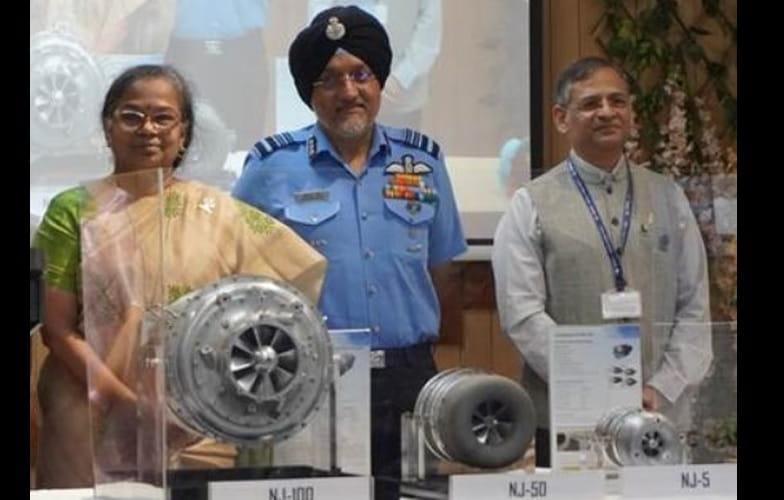
Photo: IANS
The CSIR-National Aerospace Laboratories (CSIR-NAL) has unveiled three indigenously developed micro and small gas turbine engines designed to power unmanned aerial vehicles (UAVs), drone interceptors and compact missile systems.
The engines — NJ-05, NJ-50 and NJ-100 — have thrust capacities of 5 kg, 50 kg and 100 kg, respectively. According to the Ministry of Science & Technology, the new propulsion systems are aimed at addressing critical requirements in India's growing indigenous defence and aerospace technology ecosystem.
The engines were unveiled at the SSB Auditorium at CSIR headquarters in New Delhi in the presence of senior officials from the country's defence and scientific communities. Air Marshal Tejinder Singh, Chief of Integrated Defence Staff to the Chairman Chiefs of Staff Committee (CISC), attended the event as the chief guest.
CSIR-NAL Director Abhay A Pashilkar said the laboratory is developing into a multi-stage technology integrator for India's expanding drone ecosystem. He also highlighted the potential for Indian companies, including the country's growing aerospace start-up sector, to manufacture the engines on a larger scale and meet the requirements of the domestic defence industry.
The CSIR-NAL scientific team, led by R Prathapanayaka, presented details of the engine development programme. The presentation highlighted advances in high-RPM turbomachinery and high-temperature combustion technologies, which were key to developing the indigenous propulsion systems.
CSIR Director General and Department of Scientific and Industrial Research Secretary N Kalaiselvi praised the team behind the project, describing the indigenous development of specialised and critical aerospace subsystems as an important step towards greater self-reliance in aerospace engineering.
Air Marshal Tejinder Singh also stressed the strategic importance of developing advanced gas turbine technology within India. Building domestic expertise in critical propulsion systems, he said, would help strengthen national security while reducing dependence on foreign technologies.
The development of the NJ-05, NJ-50 and NJ-100 is expected to provide a technological foundation for a domestic ecosystem focused on designing, developing and manufacturing compact gas turbine propulsion systems.
With India's UAV and drone sector expanding rapidly, the indigenous engines could help address an important component of the ecosystem: locally developed propulsion technology. The project is also expected to create opportunities for collaboration between CSIR laboratories, defence organisations, established manufacturers and emerging aerospace start-ups.




© Copyright
Reporter Post.All Rights Reserved |
Powered by: Aptilogic Software |
 |
Page rendered in 0.0934 seconds.
|
Page rendered in 0.0934 seconds.