Fri, June 12, 2026

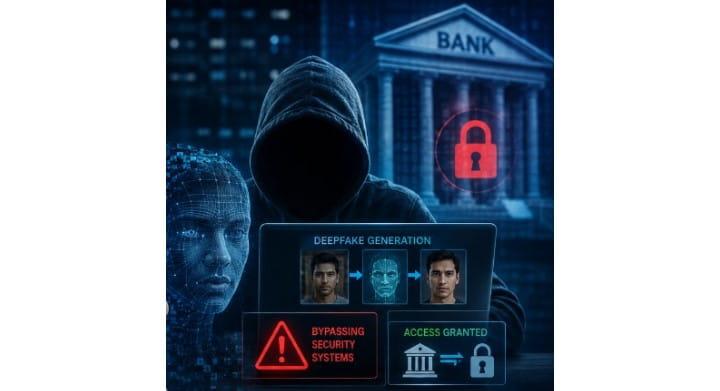
New Delhi — The Ministry of Home Affairs has sounded an alarm over the increasing use of Artificial Intelligence (AI)-generated deepfakes and synthetic identities by cybercriminals to target financial and digital systems across the country.
In a recent advisory, the National Cybercrime Threat Analytics Unit (NCTAU), operating under the Indian Cyber Crime Coordination Centre (I4C), highlighted how fraudsters are exploiting advanced AI tools to create highly convincing fake identities capable of bypassing digital security measures.
According to the advisory, cybercriminals can use AI-generated videos, images, and voice clones to deceive facial authentication systems, liveness checks, Video-KYC processes, account recovery mechanisms, and other identity verification tools used by banks and digital service providers.
The NCTAU explained that these scams often begin through social media platforms, messaging apps, job portals, dating websites, or direct phone calls. Once contact is established, fraudsters attempt to gather facial data from victims. In some cases, publicly available photos and videos are sufficient, while in others, victims are tricked into performing actions such as blinking, turning their heads, or speaking on camera during video calls or fake job interviews.
Using AI-powered deepfake technology, the collected data is then transformed into realistic digital replicas that can mimic a person's facial expressions, eye movements, gestures, and even voice patterns.
The advisory warned that if institutions lack effective deepfake detection systems, these fabricated identities could be used to bypass facial recognition and liveness verification safeguards. Such breaches may enable fraudsters to complete Know Your Customer (KYC) formalities fraudulently and gain access to financial accounts for illegal activities.
To address the emerging threat, the Home Ministry has urged banks, fintech companies, and digital service providers to strengthen customer onboarding systems with advanced tools capable of detecting deepfakes and other AI-generated content.
For individuals, the advisory recommends locking biometric profiles wherever possible, describing it as one of the most effective safeguards against remote identity theft. Users have also been advised to regularly monitor email notifications and account alerts for signs of unauthorised login attempts or suspicious activity.
The NCTAU further urged citizens to report any suspected cases of identity theft or financial fraud through the National Cyber Crime Reporting Portal, along with relevant details such as phone numbers, links, and communication records associated with the scam.
Authorities also cautioned users to be alert to sudden disruptions in mobile network connectivity, as such incidents may indicate a SIM swap attack aimed at taking control of mobile-linked accounts.
The advisory clarified that it has been issued as a preventive measure to raise awareness about evolving AI-enabled cyber threats and should not be interpreted as indicating vulnerabilities in any specific organisation, platform, or authentication system.
With inputs from IANS




| 14-09-2018 | ||||||
| Sl No. | Parameters | Actual Data(µg/m3) | Standard Limit(µg/m3) |
|---|---|---|---|
| 1 | PM 10 | 64 | 100 |
| 2 | PM 2.5 | 33 | 60 |
| 3 | SO2 | 55.3 | 80 |
| 4 | NO2 | 58.2 | 80 |
| 14-09-2018 | ||||||
| Station | Temperature(degree centigrade) | Rainfall(mm) | Relative humidity(%) | |||
|---|---|---|---|---|---|---|
| Max | Min | Past 24 hrs. | Since 1st March, 2018 | Max | Min | |
| Ranchi | 31.0 | 22.5 | 000.0 | 1010.1 | 95 | 66 |
| Jamshedpur | 34.1 | 26.2 | 000.0 | 1252.8 | 87 | 58 |
| Bokaro | 33.5 | 24.6 | 015.2 | 824.0 | 92 | 79 |
| Daltonganj | 32.6 | 24.9 | 004.2 | 960.9 | 95 | 67 |
© Copyright
Reporter Post.All Rights Reserved |
Powered by: Aptilogic Software |
 |
Page rendered in 0.1078 seconds.
|
Page rendered in 0.1078 seconds.