Sat, April 18, 2026

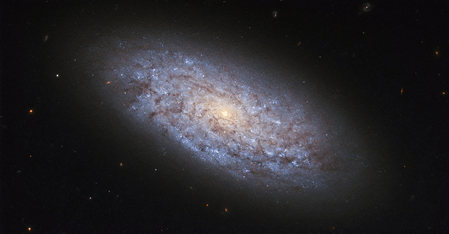
A recent study by Indian researchers suggests that even some of the smallest galaxies in the universe—known as dwarf spheroidal galaxies—could host black holes. These faint galaxies orbit the Milky Way and have long been difficult to study due to their low brightness and lack of gas.
The research, conducted by K. Aditya and Arun Mangalam from the Indian Institute of Astrophysics, explored whether such galaxies might contain central black holes. To investigate this, the team developed detailed models that account for three key components influencing gravity: stars, dark matter, and a potential black hole at the center.
By analyzing high-quality data on how stars move within these galaxies, the scientists were able to estimate the possible mass of any central black hole. Their findings indicate that if black holes are present, they are likely to be relatively small—generally less than one million times the mass of the Sun, with some galaxies allowing for even smaller limits.
According to Arun Mangalam, the data does not demand the existence of massive black holes in these galaxies, but it is fully consistent with the presence of intermediate-mass black holes.
The study carries significant implications for our understanding of how galaxies and black holes evolve. It establishes a consistent relationship that extends even to the smallest galaxies, offering a valuable reference point for future theoretical models and simulations.
This research also comes at a crucial time, as next-generation observatories like the proposed National Large Optical Telescope (NLOT) and the Extremely Large Telescope (ELT) are expected to dramatically improve our ability to observe faint and distant objects. These advanced facilities will allow scientists to measure stellar movements in much greater detail, potentially uncovering clearer evidence of black holes in such elusive galaxies.
While supermassive black holes are commonly found at the centers of large galaxies, detecting them in dwarf spheroidal galaxies remains a major challenge due to their dim nature and dominance of dark matter. This study provides a strong framework to guide future observations and deepen our understanding of these mysterious cosmic structures.
With inputs from IANS




| 14-09-2018 | ||||||
| Sl No. | Parameters | Actual Data(µg/m3) | Standard Limit(µg/m3) |
|---|---|---|---|
| 1 | PM 10 | 64 | 100 |
| 2 | PM 2.5 | 33 | 60 |
| 3 | SO2 | 55.3 | 80 |
| 4 | NO2 | 58.2 | 80 |
| 14-09-2018 | ||||||
| Station | Temperature(degree centigrade) | Rainfall(mm) | Relative humidity(%) | |||
|---|---|---|---|---|---|---|
| Max | Min | Past 24 hrs. | Since 1st March, 2018 | Max | Min | |
| Ranchi | 31.0 | 22.5 | 000.0 | 1010.1 | 95 | 66 |
| Jamshedpur | 34.1 | 26.2 | 000.0 | 1252.8 | 87 | 58 |
| Bokaro | 33.5 | 24.6 | 015.2 | 824.0 | 92 | 79 |
| Daltonganj | 32.6 | 24.9 | 004.2 | 960.9 | 95 | 67 |
© Copyright
Reporter Post.All Rights Reserved |
Powered by: Aptilogic Software |
 |
Page rendered in 0.0175 seconds.
|
Page rendered in 0.0175 seconds.