Sat, October 03, 2026

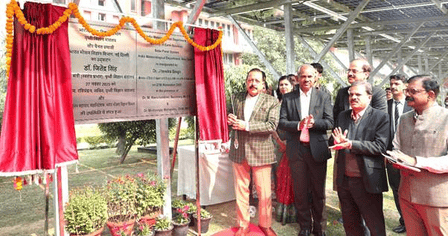
New Delhi — The Union Government on Thursday inaugurated three major India Meteorological Department (IMD) initiatives: two advanced Doppler Weather Radars (DWRs), a large-scale solar power system at Mausam Bhawan, and a state-of-the-art Meteorological Museum.
Launching the projects, Dr. Jitendra Singh, Union Minister of State (Independent Charge) for Science & Technology, said the IMD is quickly advancing Prime Minister Narendra Modi’s ‘Mission Mausam’, announced during the department’s 150th anniversary celebrations earlier this year.
“We had committed to increasing the radar network from 47 to nearly three times by 2027. I am pleased to report that in just a few months, we have reached 126 radars. With two years still left, we are confident of meeting—and even surpassing—the target,” Singh said.
The first newly commissioned dual-polarised C-Band Doppler radar, installed at Indira Gandhi Krishi Vishwavidyalaya in Raipur, Chhattisgarh, will monitor monsoon depressions, low-pressure areas, heavy rainfall, thunderstorms, lightning, squalls, hailstorms, and turbulence within a 250 km radius.
Its coverage spans Chhattisgarh, interior Odisha, eastern Madhya Pradesh, southwest Jharkhand, and southern East Uttar Pradesh—plugging a critical data gap and strengthening IMD’s forecasting accuracy.
The second radar, installed at IMD’s RS/RW Office in Shakthi Nagar, Mangaluru, Karnataka, enhances real-time monitoring of cyclones, thunderstorms, squalls, heavy rain, lightning, hailstorms, and turbulence.
With a 250 km observational range, it will track weather systems over the Arabian Sea, northern Lakshadweep, Goa, South Konkan, and parts of Karnataka, Kerala, and South Maharashtra.
A new Meteorological Museum was also inaugurated to inspire students, researchers, and young learners. The museum showcases IMD’s evolution over 150 years, featuring vintage weather instruments, upper-air systems, communication tools, radar and satellite components, along with interactive audio-visual exhibits.
Dr. Singh urged IMD to organise structured educational tours, calling the museum “a journey through a century of scientific progress.”
Aligned with India’s clean energy goals, IMD also installed a 771 kWp solar power system across the Mausam Bhawan Complex, featuring 1,315 solar panels installed by NBCC.
Singh noted that the initiative supports the PM Surya Ghar Muft Bijli Yojana, contributes to India’s net-zero goals, and serves as a model for sustainable government infrastructure.
“IMD has now achieved over 50 percent radar coverage and is planning additional installations, including urban radars in Delhi, Chennai, Mumbai, and Kolkata, as well as advanced phased-array radars for Jammu & Kashmir, Uttarakhand, and Himachal Pradesh,” said Dr. M. Ravichandran, Secretary, Ministry of Earth Sciences.
--With inputs from IANS



© Copyright
Reporter Post.All Rights Reserved |
Powered by: Aptilogic Software |
 |
Page rendered in 0.0133 seconds.
|
Page rendered in 0.0133 seconds.