Sat, August 22, 2026


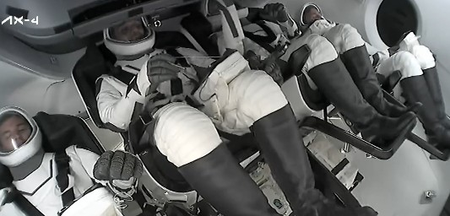
New Delhi — IAF Group Captain Shubhanshu Shukla is on the verge of creating history as the first Indian to reach the International Space Station (ISS). Shukla, along with three other astronauts from the US, Poland, and Hungary, is scheduled to dock at the orbiting space laboratory today at 7 a.m. EDT (4:30 p.m. IST).
Born in Lucknow, Shukla launched to the ISS at 2:31 a.m. EDT (12 noon IST) aboard a SpaceX Dragon spacecraft, which lifted off from Launch Complex 39A at NASA’s Kennedy Space Center in Florida, carried by a Falcon 9 rocket.
In an update, NASA stated, "The SpaceX Dragon spacecraft carrying four Axiom Mission 4 (Ax-4) crew members is orbiting Earth and en route to the International Space Station after launching from Kennedy Space Center at 2:31 a.m. EDT on Wednesday."
The Dragon spacecraft is carrying Ax-4 Commander Peggy Whitson, Pilot Shubhanshu Shukla, and Mission Specialists S?awosz Uzna?ski-Wi?niewski and Tibor Kapu.
NASA confirmed that the spacecraft "will dock to the space-facing port of the ISS’s Harmony module at 7 a.m. on Thursday."
This marks a historic moment for India, as Shukla becomes the first Indian to visit the ISS and only the second Indian in space since Rakesh Sharma’s mission in 1984.
Sharing a message during the journey, Shukla said, "Namaskar, my dear countrymen! What a ride! After 41 years, India is back in space. It’s an incredible experience. We are orbiting Earth at a speed of 7.5 kilometers per second."
"This is not just my personal journey. I carry the Indian flag with me. This is the journey of India's human space exploration," he added.
In a heartwarming touch, Shukla has carried carrot halwa, moong dal halwa, and mango nectar with him to enjoy some flavors of home while in space.
The Axiom-4 mission marks not just a scientific milestone but also highlights India’s growing leadership in global space technology and innovation. It reflects the nation’s ability to contribute significantly to sustainable space exploration.
Once aboard the ISS, Shukla will conduct pioneering experiments in food and space nutrition, developed through collaboration between ISRO, the Department of Biotechnology (DBT), and supported by NASA.
The research will explore the potential of edible microalgae—a nutrient-rich food source ideal for long-duration space missions. Scientists will study how microgravity and space radiation affect algae growth, analyzing transcriptomic, proteomic, and metabolomic changes compared to Earth-based conditions.
These experiments aim to advance sustainable life-support systems, a key requirement for future human space travel.
With inputs from IANS




© Copyright
Reporter Post.All Rights Reserved |
Powered by: Aptilogic Software |
 |
Page rendered in 0.0798 seconds.
|
Page rendered in 0.0798 seconds.