Mon, October 12, 2026
Representational Pic, Image credit IANS
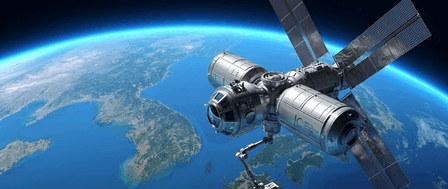
India's first manned space mission, Gaganyaan, is expected to carry three astronauts, including a woman, into space for seven days and place the spacecraft in a low Earth orbit at an altitude of 300-400 km.
Giving details of the programme at a press conference here, Minister of State for Atomic Energy and Space Jitendra Singh said the GSLV Mk III, India's three-stage heavy-lift launch vehicle, would be used to launch Gaganyaan because of its required payload capacity.
He said two unmanned missions would be carried out before the first human spaceflight.
According to the schedule outlined by ISRO, the first and second unmanned missions were planned to be launched within 30 and 36 months respectively from August 2018. The first manned mission was expected within 40 months, around December 2021 or January 2022.
The Gaganyaan Orbital Module has a mass of around seven tonnes and consists of a service module and a crew module. The crew module, which will carry the three astronauts, is designed to have a diameter of 3.7 metres and a height of seven metres.
"The total programme is expected to be completed before 2022, with the first unmanned flight within 30 months. The mission will aim to send a three-person crew to space for a period of seven days. Two men and one woman would be part of the crew. The spacecraft will be placed in a low Earth orbit of 300-400 km. The programme is expected to cost less than Rs 10,000 crore," Singh said.
Prime Minister Narendra Modi had announced the Gaganyaan mission during his Independence Day address. He had said that by 2022, or even earlier, Indian boys and girls would unfurl the Tricolour in space.
Singh said the ambitious programme would be a national endeavour involving ISRO, academic institutions, industry and other government and private agencies.



© Copyright
Reporter Post.All Rights Reserved |
Powered by: Aptilogic Software |
 |
Page rendered in 0.0102 seconds.
|
Page rendered in 0.0102 seconds.