Wed, October 14, 2026

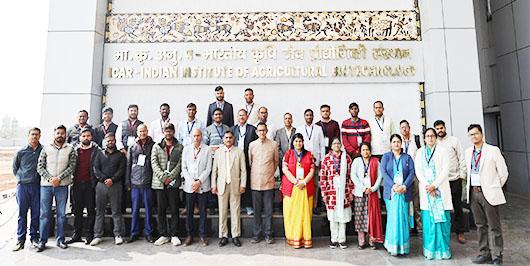
A 21-day Winter School on “Translational Genomics for Climate-Resilient Cultivar Development” was inaugurated on February 3, 2026, at ICAR–Indian Institute of Agricultural Biotechnology (ICAR-IIAB), Ranchi. The programme will run from February 3 to 23, 2026. Prof. (Dr.) Ashok R. Patil, Vice-Chancellor of the National University of Study and Research in Law (NUSRL), Ranchi, graced the inaugural session as the Chief Guest. The Winter School has brought together 20 scientists, assistant professors, and faculty members from ICAR institutes, State Agricultural Universities (SAUs), and UGC-recognized universities across India.
The training programme aims to strengthen participants’ conceptual understanding and practical expertise in utilizing omics technologies and genomic databases for precision-based, climate-resilient crop improvement. The curriculum includes key areas such as structural, functional, and translational genomics; genomics-assisted breeding; sequencing and genome assembly tools; structural bioinformatics; molecular markers and trait discovery; multi-omics data integration; systems biology approaches; and advanced computational tools with artificial intelligence integration for modern breeding strategies.
In his address, Dr. Sujay Rakshit, Director, ICAR-IIAB, Ranchi, highlighted the vital contribution of agriculture and agricultural research to national development and economic progress. He reflected on India’s transformation from food scarcity at the time of independence to significant agricultural self-reliance, achieved through the combined efforts of farmers, scientific innovation, and institutional support led by ICAR. He emphasized the need to equip young scientists to tackle emerging challenges such as climate change, resource limitations, and evolving food demands, aligning their efforts with the vision of Viksit Bharat by 2047.
Chief Guest Prof. (Dr.) Ashok R. Patil shared insights from his experience in policymaking, noting that agriculture and farmers remain central to national policy frameworks, with a strong focus on sustainability and farmers’ welfare. He also acknowledged ICAR’s leadership in strengthening India’s agricultural research and development ecosystem.
The inaugural session began with a formal welcome address by Dr. V. P. Bhadana, followed by a vote of thanks delivered by Dr. K. R. Soren. Faculty members and staff of ICAR-IIAB were also present on the occasion.



© Copyright
Reporter Post.All Rights Reserved |
Powered by: Aptilogic Software |
 |
Page rendered in 0.012 seconds.
|
Page rendered in 0.012 seconds.