Wed, September 09, 2026
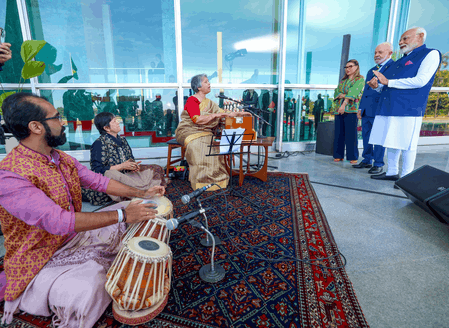
Photo: IANS
India has assumed the BRICS Chairship for the fourth time in 2026, with the grouping continuing to work across three broad pillars — political and security cooperation, economic and financial engagement, and culture and people-to-people exchanges.
At a time when conflicts and geopolitical tensions are deepening divisions across the world, the cultural and people-to-people dimension of BRICS can play a particularly important role. While political and economic partnerships are often shaped by changing strategic interests, cultural ties can create deeper and more durable connections among societies.
People-to-people exchanges have been an important part of the BRICS framework. Prime Minister Narendra Modi had said at last year’s BRICS Summit that India would take forward the forum with a people-centric approach and in the spirit of ‘Humanity First’. India’s theme for its 2026 chairship — ‘Building for Resilience, Innovation, Cooperation and Sustainability’ — is closely aligned with that vision.
The emphasis on culture is particularly relevant given the deep historical links among several BRICS societies. India, China and Russia, for instance, were connected through the ancient Silk Routes, which facilitated far more than the movement of merchandise. Ideas, religions, philosophies, scientific knowledge and artistic traditions travelled along these routes, creating cultural connections that survived political boundaries.
Several BRICS countries also share experiences of colonialism, independence movements, economic inequality and the challenges of modernisation. Their histories are not identical, but these experiences have shaped common aspirations for sovereignty, development and a more representative international system.
These historical connections demonstrate that interaction among BRICS societies is not a new phenomenon. Many of their traditional value systems also placed emphasis on family, community and the inherent equality of human beings. Building on such shared civilisational experiences could help create stronger bonds between people.
The cultural diversity of BRICS can also become a practical resource for addressing contemporary global challenges. Indigenous knowledge and traditional practices across member countries offer valuable insights into biodiversity conservation, agriculture, community organisation and sustainable ways of living.
Greater exchange of such knowledge could contribute to efforts to tackle climate change, food insecurity and environmental degradation. Rather than treating traditional knowledge merely as cultural heritage, BRICS could explore ways to connect it with modern research, innovation and sustainable development.
The BRICS Civil Forum 2026 provided an important platform for advancing this conversation. Nearly 80 civil society organisations from BRICS countries participated, including 26 from India. One of the key messages emerging from the culture working group was that long-term cultural cooperation would require institutional continuity and predictable financing.
A dedicated BRICS Culture Fund could therefore be considered to support regular programmes, collaborations and exchanges. Such a mechanism could help move cultural cooperation beyond one-off festivals and events and establish a sustained framework for people-to-people engagement.
Technology can provide another important avenue for cooperation. Digitisation and artificial intelligence can help preserve both tangible and intangible cultural heritage, while also making cultural knowledge more accessible to younger generations.
A collaborative digital platform could document endangered traditions, languages, crafts, music, performing arts and indigenous knowledge across BRICS countries. Such initiatives would not only preserve heritage but also facilitate inter-generational transmission.
Tourism offers another practical opportunity to connect cultural diplomacy with economic development. BRICS could explore Cultural Tourism Corridors linking important heritage destinations across member countries.
Such corridors could encourage greater people-to-people contact while generating employment and income for local communities. A BRICS Interactive Heritage Map, supported by geographical indicators, digital marketplaces and e-commerce platforms, could further help artisans, artists and cultural entrepreneurs access wider domestic and international markets.
For cultural cooperation to have a lasting impact, however, younger generations must be placed at its centre. Cultural relationships become stronger when young people experience other societies directly rather than encountering them only through diplomatic or institutional exchanges.
Under the Indian Council for Cultural Relations (ICCR) framework, India could consider promoting an annual BRICS Culture Festival along with culture diplomacy fellowships for artists, curators and researchers. Regular exchanges, fellowships and joint creative projects could create long-term networks among young people across BRICS societies.
Women and youth should have a central role in these initiatives. Their participation would help ensure that cultural diplomacy is not limited to established institutions but reaches wider communities and reflects the diversity of contemporary BRICS societies.
For a grouping as culturally diverse as BRICS, cooperation does not require uniformity. Its strength lies in recognising differences while creating platforms for dialogue, exchange and mutual learning.
By placing heritage, creativity, communities and young people at the heart of its cultural agenda, BRICS can build cultural bridges that complement its economic and political partnerships. A sustained, community-driven and digitally enabled approach could deepen mutual understanding and contribute to a more inclusive, sustainable and people-centred global order.
Culture, therefore, should not be viewed as a peripheral component of BRICS diplomacy. It is a strategic resource that can foster mutual respect, strengthen people-to-people relationships and develop a greater sense of shared purpose.
The long-term cohesion of BRICS will depend not only on trade, investment and political coordination, but also on how effectively its societies understand, engage with and celebrate one another. Cultural diplomacy can help transform BRICS from a partnership primarily among states into a broader partnership among societies.
India is particularly well placed to lead this conversation. With hundreds of living languages, thousands of dialects and a vast range of artistic, performing, textile, culinary and spiritual traditions, India has long demonstrated that unity does not require uniformity. Diversity, when recognised and respected, can become a source of strength rather than division.
Culture is ultimately a foundation of social resilience, inclusive development and cohesion because it embodies the values, identity and ethos of societies. BRICS has traditionally been viewed as a grouping of states. It is now time to recognise it equally as a grouping of diverse cultures and civilisations.
(The author is a consultant at New Delhi-based Research and Information System for Developing Countries. Views expressed are personal.)


© Copyright
Reporter Post.All Rights Reserved |
Powered by: Aptilogic Software |
 |
Page rendered in 0.0123 seconds.
|
Page rendered in 0.0123 seconds.