Thu, October 15, 2026

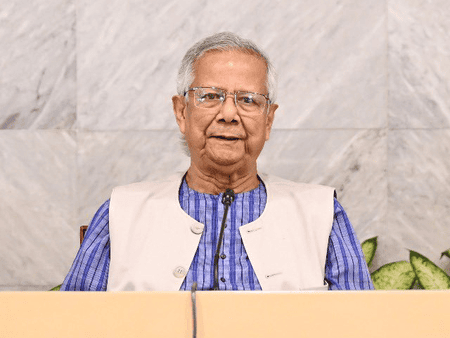
New Delhi — Muhammad Yunus, who was appointed as the head of Bangladesh’s interim government, has faced allegations from critics who claim that his recent political moves are aimed at strengthening his hold on power even after the upcoming elections. Observers have also expressed concerns over Bangladesh’s growing engagement with countries like Pakistan and China during his tenure.
One of Yunus’ earliest and most controversial decisions was banning the Awami League, the party led by former Prime Minister Sheikh Hasina, after her removal from power. The Awami League has described the ban as unjust, and tensions between its supporters and members of rival groups, including Jamaat-e-Islami and the Bangladesh Nationalist Party (BNP), have led to frequent violent clashes. Analysts fear that such unrest could continue even after the elections.
Reports suggest that Yunus may have reached an understanding with Jamaat-e-Islami, under which he could be considered for the presidency if the party wins the elections. Critics allege that several concessions have been made to improve Jamaat’s electoral prospects. There are also allegations that certain individuals, including those accused of extremist activities and criminal offences, have been released from prison during his tenure, contributing to rising law and order concerns.
Security observers claim that continued instability could create a situation where emergency constitutional provisions might be invoked. Under Article 141A of the Bangladesh Constitution, the President has the authority to assume emergency powers during times of national crisis. Historically, similar provisions have been used in Bangladesh during periods of political turmoil, including in 1975, 1981, and 2007.
Political analysts believe that Yunus’ position could become uncertain if the BNP forms the government. The BNP’s internal dynamics, including its rivalry with Jamaat-e-Islami and the return of senior leader Tarique Rahman, are expected to further intensify political competition. Large-scale protests or violence involving these parties could potentially create conditions for constitutional emergency measures.
Supporters of the Awami League are also expected to challenge the legitimacy of the elections, which may further contribute to political instability. Meanwhile, legal cases previously filed against Yunus and organisations linked to him, including Grameen Bank and Grameen Telecom, have reportedly stalled. These cases involved allegations such as financial irregularities, labour law violations, and misuse of funds. Critics claim that halting these proceedings has helped Yunus rebuild his public image.
Some political observers suggest that Yunus may have preferred to continue leading the interim administration for a longer period but eventually announced elections to avoid criticism over delaying democratic processes.
Experts monitoring Bangladesh’s political developments believe that the country faces significant challenges in restoring stability. They also emphasise the importance of regional security, particularly for neighbouring countries, amid growing political and social tensions within Bangladesh.
With inputs from IANS



© Copyright
Reporter Post.All Rights Reserved |
Powered by: Aptilogic Software |
 |
Page rendered in 0.0144 seconds.
|
Page rendered in 0.0144 seconds.