Sun, May 24, 2026

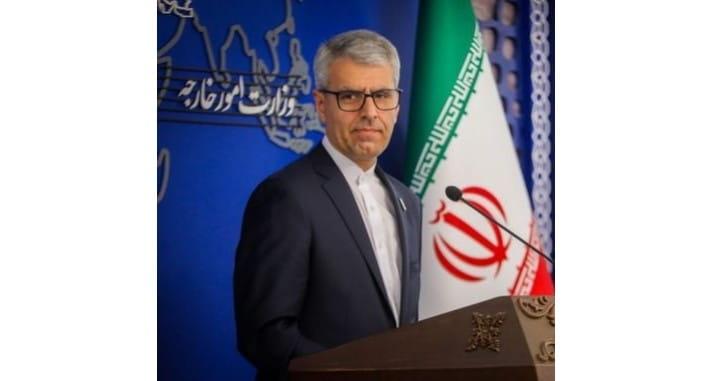
Tehran- Esmaeil Baghaei on Saturday said that Iran and the United States are working towards finalising a memorandum of understanding (MoU) aimed at ending the ongoing conflict in the region.
Speaking to Iran’s state-run IRIB news agency after a Pakistani delegation visited Tehran on Friday, Baghaei said the immediate priority for Tehran remains ending what it described as the “imposed war.”
The Pakistani delegation included Asim Munir and Mohsin Naqvi.
“At this stage, our focus is on ending the imposed war,” Baghaei said, adding that both sides are trying to reach agreement on a 14-clause MoU.
“Our intention has been to firstly agree on a MoU consisting of 14 clauses,” he said, noting that a final agreement could be reached within 30 to 60 days after the document is formally approved.
According to Baghaei, discussions currently centre on ending hostilities across all fronts, including Lebanon. He said major issues under negotiation include halting what Iran described as US maritime attacks or naval blockades, as well as securing the release of frozen Iranian assets.
Clarifying the proposed timeline, Baghaei said the 30- to 60-day period mentioned in the draft would begin only after the MoU is officially finalised.
“We should wait and see what will happen within the next three to four days,” he said, while also noting that Iran’s nuclear programme is not currently part of the peace negotiations.
Baghaei highlighted Pakistan’s role as the primary mediator between Tehran and Washington, saying Islamabad has played an “important role” in maintaining communication between the two sides.
Iran, the United States and Israel had reached a ceasefire on April 8 following 40 days of conflict that began with US and Israeli attacks on Iran on February 28.
After the ceasefire, Iranian and American representatives held talks in Islamabad on April 11 and 12, though the discussions reportedly ended without a breakthrough agreement.
In recent weeks, both sides have continued exchanging proposals outlining conditions for ending the conflict through Pakistani mediation.
With inputs from IANS




| 14-09-2018 | ||||||
| Sl No. | Parameters | Actual Data(µg/m3) | Standard Limit(µg/m3) |
|---|---|---|---|
| 1 | PM 10 | 64 | 100 |
| 2 | PM 2.5 | 33 | 60 |
| 3 | SO2 | 55.3 | 80 |
| 4 | NO2 | 58.2 | 80 |
| 14-09-2018 | ||||||
| Station | Temperature(degree centigrade) | Rainfall(mm) | Relative humidity(%) | |||
|---|---|---|---|---|---|---|
| Max | Min | Past 24 hrs. | Since 1st March, 2018 | Max | Min | |
| Ranchi | 31.0 | 22.5 | 000.0 | 1010.1 | 95 | 66 |
| Jamshedpur | 34.1 | 26.2 | 000.0 | 1252.8 | 87 | 58 |
| Bokaro | 33.5 | 24.6 | 015.2 | 824.0 | 92 | 79 |
| Daltonganj | 32.6 | 24.9 | 004.2 | 960.9 | 95 | 67 |
© Copyright
Reporter Post.All Rights Reserved |
Powered by: Aptilogic Software |
 |
Page rendered in 0.0869 seconds.
|
Page rendered in 0.0869 seconds.