Fri, October 16, 2026


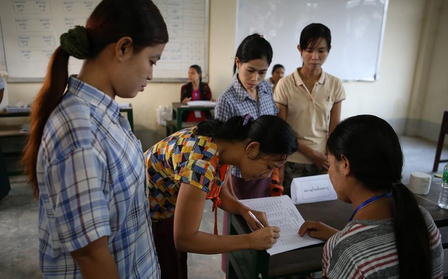
Yangon- Myanmar on Sunday launched the first phase of its 2025 multi-party democratic general election, marking a significant political milestone five years after the outbreak of the civil war.
The nationwide election is being conducted in three phases. The second phase is scheduled for January 11, 2026, followed by the third and final phase on January 25.
The polls will cover 692 constituencies across the country, with nearly 5,000 candidates from 57 political parties contesting seats in the Pyithu Hluttaw (Lower House), Amyotha Hluttaw (Upper House), and the State and Region Hluttaws (State and Region Parliaments).
The election will result in the formation of the Union Parliament, comprising the Pyithu Hluttaw and Amyotha Hluttaw, as well as State and Region Parliaments. The newly constituted Union Parliament will then elect a president, who will go on to form the next Union Government, according to Xinhua news agency.
The Union Election Commission said that a total of 21,517 polling stations have been established nationwide to facilitate voting.
In a major departure from previous elections, Myanmar has introduced the Mixed-Member Proportional (MMP) electoral system along with the use of Myanmar Electronic Voting Machines. The MMP system blends the First-Past-the-Post method with Proportional Representation, the state-run daily Global New Light of Myanmar reported.
The Ministry of Information stated that Myanmar citizens residing abroad have already cast advance votes at embassies and consulates overseas. In addition, election observers from several countries have arrived in Myanmar to monitor the polling process.
Myanmar last held a general election in November 2020.
The 2025 election has also seen a notable rise in women’s participation. A total of 1,183 female candidates are contesting parliamentary seats, according to the Information Team of the National Defence and Security Council. This marks a significant increase from 908 women candidates in 2020 and 799 in the 2015 elections.
The rise in female participation has been attributed to the adoption of the proportional representation system, which has encouraged more women to enter electoral politics, said U Khin Maung Oo, a member of the Union Election Commission.
With inputs from IANS



© Copyright
Reporter Post.All Rights Reserved |
Powered by: Aptilogic Software |
 |
Page rendered in 0.0152 seconds.
|
Page rendered in 0.0152 seconds.