Sun, October 11, 2026

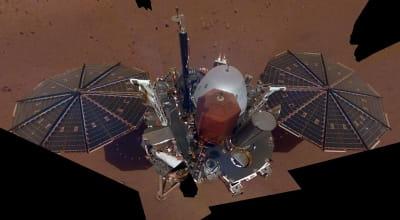
Photo: IANS
NASA’s InSight spacecraft has crossed the halfway point on its journey to Mars, with all of its scientific instruments and major spacecraft systems reported to be functioning properly, the US space agency said.
InSight, short for Interior Exploration using Seismic Investigations, Geodesy and Heat Transport, is designed to study the deep interior of Mars and help scientists understand how rocky planets, including Earth, formed and evolved.
The spacecraft crossed the halfway mark on August 6, about 107 days after its launch. NASA expects InSight to reach Mars on November 26 and land in the Elysium Planitia region, where it will begin its scientific mission.
So far, the spacecraft has travelled around 277 million km. During the remaining 98 days of its journey, it is expected to cover another 208 million km before reaching the Red Planet.
The mission was originally planned around the period when Mars was closest to Earth on July 31. However, the spacecraft's arrival comes at a challenging time for NASA's Mars programme, as a massive dust storm on the planet has disrupted communication with the agency's Opportunity rover.
NASA engineers have used InSight's long cruise through space to activate and test the systems it will need during its arrival and surface operations. They have also been checking the spacecraft's scientific instruments to ensure they are ready for the demanding mission ahead.
One of InSight's most important instruments is a highly sensitive seismometer that will detect seismic activity, or "marsquakes", beneath the planet's surface. The lander also carries a self-hammering heat probe designed to penetrate the Martian soil and measure heat escaping from the planet's interior.
The spacecraft is also equipped with cameras that will document its equipment and surroundings. One of the cameras has already captured an important image of the spacecraft's own components, giving engineers confirmation that it is functioning as intended.
"If you are an engineer on InSight, that first glimpse of the heat shield blanket, harness tie-downs and cover bolts is a very reassuring sight as it tells us our Instrument Context Camera is operating perfectly. The next picture we plan to take with this camera will be of the surface of Mars," said Tom Hoffman, InSight Project Manager at NASA's Jet Propulsion Laboratory in California.
The camera is expected to capture InSight's first view of the Elysium Planitia landing site just minutes after the spacecraft touches down.
Once operational, InSight's measurements could provide scientists with a rare look beneath the Martian surface. By studying the planet's internal structure, seismic activity and heat flow, researchers hope to gain a better understanding of Mars and the early history of rocky planets across the solar system.



© Copyright
Reporter Post.All Rights Reserved |
Powered by: Aptilogic Software |
 |
Page rendered in 0.0187 seconds.
|
Page rendered in 0.0187 seconds.