Fri, October 02, 2026

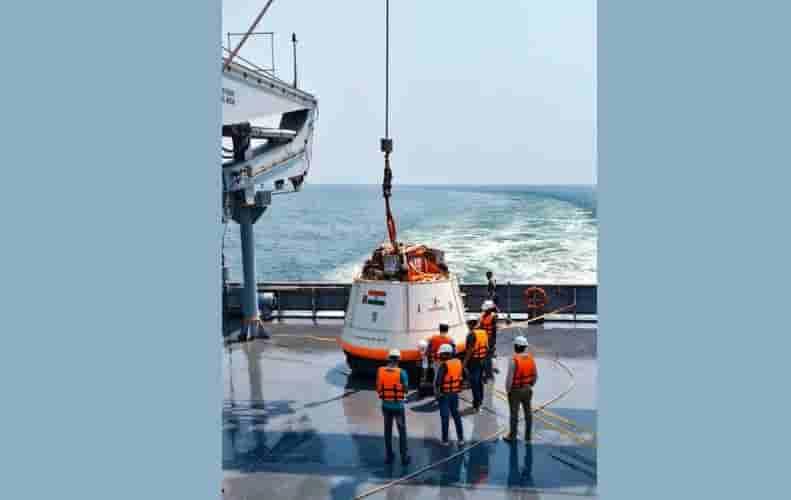
Photo: IANS
India is steadily expanding its role in the global space sector, moving from the early use of satellites for national development to advanced scientific missions, human spaceflight and plans for a space station, according to an article published by Tanzania’s The Guardian.
The report traces the country’s journey from the launch of Aryabhata in 1975 to landmark missions such as Chandrayaan-3 and Aditya-L1, along with the ongoing Gaganyaan programme and plans for the Bharatiya Antariksh Station.
India’s space programme, the article notes, is increasingly influencing areas far beyond rockets and satellites. Space-based technologies are supporting communications, agriculture, education, healthcare, navigation, disaster management and environmental monitoring, while also contributing to industrial development, employment and scientific research.
The Chandrayaan-3 mission in 2023 marked a major milestone after India successfully achieved a controlled landing on the lunar surface. Aditya-L1 subsequently expanded the country's scientific programme to solar observation, while the SpaDeX mission demonstrated orbital docking capabilities — an important technology for more complex future missions.
India is also preparing for Chandrayaan-4, which was approved in 2024 and is designed to bring lunar samples back to Earth. Unlike a landing-only mission, a sample-return mission requires a more complex sequence of operations, including multiple launches, orbital rendezvous and docking, collection of samples, ascent from the Moon and their safe return to Earth.
The country's planetary exploration plans also extend to Venus. The Shukrayaan, or Venus Orbiter Mission, is targeted for launch in March 2028 and is intended to study the planet's atmosphere, surface and subsurface. Meanwhile, Aditya-L1 operates around 1.5 million km from Earth and is studying solar activity and space weather.
Human spaceflight represents another major step in India's space programme. Through Gaganyaan, the Indian Space Research Organisation (ISRO) is developing the systems required to safely send astronauts into space and bring them back to Earth.
Human missions demand significantly higher levels of reliability than conventional satellite launches. Crew escape systems, life-support equipment, parachutes, re-entry systems and extensive testing are among the critical technologies required. India is following a phased approach, with uncrewed missions being used to validate key systems before crewed flights.
The Gaganyaan programme is also part of a longer-term roadmap. India plans to begin the Bharatiya Antariksh Station with its first module in 2028, with the station envisaged for completion by 2035. The broader roadmap also includes a proposed crewed Indian lunar mission by 2040.
The expansion of the space programme is expected to have significant implications on Earth as well. Satellite-based services have become important tools for weather forecasting, agriculture, navigation, telecommunications, disaster response and environmental monitoring.
Earth-observation satellites can help authorities monitor areas vulnerable to floods, cyclones and landslides, while satellite communication can assist emergency services operating in remote locations. Space-based data is also being used to monitor forests, water resources, urban expansion, pollution and changing weather patterns, supporting environmental management and disaster preparedness.
The benefits extend into healthcare and education. Satellite connectivity can help provide healthcare services to remote communities, while augmented and virtual reality technologies can support medical education and specialised training.
India's space investments are also generating technological spillovers across the wider economy. Advances in electronics, sensors, materials, communications, navigation and manufacturing developed for space applications can be adapted for other industries. Technology transfers have also helped strengthen domestic manufacturing and create opportunities for Indian companies to participate in more advanced supply chains.
One example cited in the article is the development of more than 900 application-specific integrated circuits by ISRO's Semi-Conductor Laboratory for use in railway locomotives.
The broader impact of India's space programme, therefore, extends beyond individual missions. Investment in space research is contributing to scientific knowledge, intellectual property, specialised engineering skills, manufacturing capabilities and new commercial opportunities, reinforcing the growing links between the space sector and India's wider economy.



© Copyright
Reporter Post.All Rights Reserved |
Powered by: Aptilogic Software |
 |
Page rendered in 0.0112 seconds.
|
Page rendered in 0.0112 seconds.