Fri, July 17, 2026

Tehran: Iran's Islamic Revolutionary Guards Corps (IRGC) on Friday claimed it had launched a fresh wave of retaliatory strikes targeting US military facilities in Syria, Kuwait and Oman as regional tensions continued to escalate.
According to statements issued by the IRGC and carried by Iran's official news agency IRNA, the attacks were conducted during the 11th, 12th and 13th phases of Operation Nasr-2.
The IRGC said the 11th phase included a surprise strike on a US special operations command centre in Syria's al-Tanf region. It added that the operation was dedicated to soldiers killed in Bampur in Iran's Iranshahr region.
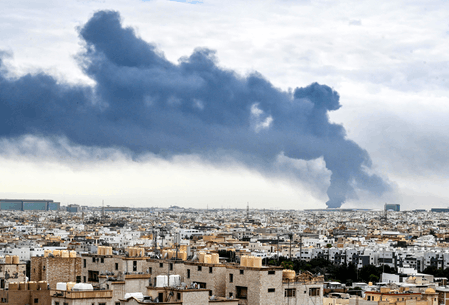
In a separate statement, the IRGC claimed its forces struck a US missile defence surveillance radar, weapons depots, two HIMARS rocket launchers and missile storage facilities at a base hosting American troops in Kuwait, triggering a large fire.
Iran also claimed that its forces destroyed a naval surveillance radar at the Salmah Plateau and a US air surveillance radar in Oman's Ghanam area.
Following the reported attacks, the Kuwaiti Army said its air defence systems were intercepting hostile missiles and drones. It urged residents to remain calm and follow safety instructions issued by the authorities.
"The sounds of explosions being heard are the result of our air defence systems intercepting hostile attacks," the Kuwaiti military said in a post on X.
The latest claims come days after Iran announced that it had carried out strikes on US military facilities in Bahrain and Jordan.
On Wednesday, the IRGC said its Aerospace Force targeted the US military base at al-Azraq in Jordan, claiming to have damaged aircraft shelters housing F-15, F-16 and F-35 fighter jets, along with several MQ-9 drones.
Iran alleged that the base had been used to support US military operations against the country and called on Jordan to end the presence of American forces. It also urged Jordanians to oppose what it described as the US military occupation.
The IRGC further claimed that its naval forces attacked facilities linked to the US Fifth Fleet in Bahrain, including command centres, equipment warehouses and fuel storage sites.
Iran said those strikes were a response to the deployment of US naval forces in the Indian Ocean and Washington's actions affecting maritime traffic near the Strait of Hormuz.
The Strait of Hormuz, which connects the Persian Gulf with the Gulf of Oman and the Arabian Sea, remains one of the world's most strategically important shipping routes, carrying a significant share of global oil and liquefied natural gas exports.
Iran's claims have not been independently verified, and there was no immediate confirmation from US, Kuwaiti or Omani authorities regarding the reported strikes or the extent of any damage.
With inputs from IANS




| 14-09-2018 | ||||||
| Sl No. | Parameters | Actual Data(µg/m3) | Standard Limit(µg/m3) |
|---|---|---|---|
| 1 | PM 10 | 64 | 100 |
| 2 | PM 2.5 | 33 | 60 |
| 3 | SO2 | 55.3 | 80 |
| 4 | NO2 | 58.2 | 80 |
| 14-09-2018 | ||||||
| Station | Temperature(degree centigrade) | Rainfall(mm) | Relative humidity(%) | |||
|---|---|---|---|---|---|---|
| Max | Min | Past 24 hrs. | Since 1st March, 2018 | Max | Min | |
| Ranchi | 31.0 | 22.5 | 000.0 | 1010.1 | 95 | 66 |
| Jamshedpur | 34.1 | 26.2 | 000.0 | 1252.8 | 87 | 58 |
| Bokaro | 33.5 | 24.6 | 015.2 | 824.0 | 92 | 79 |
| Daltonganj | 32.6 | 24.9 | 004.2 | 960.9 | 95 | 67 |
© Copyright
Reporter Post.All Rights Reserved |
Powered by: Aptilogic Software |
 |
Page rendered in 0.117 seconds.
|
Page rendered in 0.117 seconds.