Wed, July 15, 2026

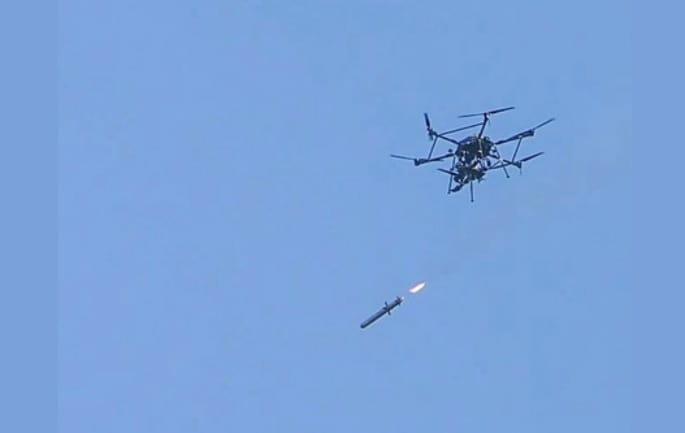
New Delhi: The Ministry of Electronics and Information Technology (MeitY), in partnership with the Drone Federation India (DFI), on Monday launched the second edition of the National Innovation Challenge for Drone Application and Research (NIDAR 2.0) for 2026-27 under the SwaYaan initiative. The programme aims to nurture the next generation of drone innovators while accelerating the development of indigenous drone technologies and autonomous systems.
Held in a hybrid format at Electronics Niketan in New Delhi, the launch brought together students, faculty members, government officials and industry representatives from across the country.
MeitY Secretary S. Krishnan unveiled the problem statements, competition poster and official rulebook for NIDAR 2.0. Addressing the gathering, he said the latest edition represents a major shift from simply operating drones to designing the intelligence that powers them.
"NIDAR 2.0 takes our students from just flying drones to building the drone's brain. When the drone's brain runs on India's own VEGA processor, we are not just training engineers. We are laying the foundation of a self-reliant drone industry," Krishnan said.
He noted that the VEGA processor has been developed under the Digital India RISC-V (DIR-V) programme, a MeitY initiative intended to reduce India's dependence on foreign chip architectures and costly licensing.
The event also featured addresses by Amitesh Kumar Sinha, Additional Secretary, MeitY and CEO of the India Semiconductor Mission, Tulika Pandey, Scientist G and Group Coordinator at MeitY, and Smit Shah, President of the Drone Federation India. Senior representatives from the Ministries of Civil Aviation, Defence and Home Affairs, the Directorate General of Civil Aviation (DGCA), the armed forces, academia and industry also attended the programme.
Building on the success of its inaugural edition launched in March 2025, NIDAR 2.0 significantly broadens the scope of the competition. The first edition saw participation from 3,448 students representing 22 states, four Union Territories and 109 cities. Participants developed autonomous drone solutions for disaster management and precision agriculture, with 93 teams qualifying for the grand finale. A total of 24 teams received prizes worth Rs 40 lakh.
The 2026-27 edition shifts the focus beyond conventional drone platforms, encouraging participants to develop autonomous systems, indigenous avionics and critical drone components, with the competition structured across two specialised tracks.
With inputs from IANS




| 14-09-2018 | ||||||
| Sl No. | Parameters | Actual Data(µg/m3) | Standard Limit(µg/m3) |
|---|---|---|---|
| 1 | PM 10 | 64 | 100 |
| 2 | PM 2.5 | 33 | 60 |
| 3 | SO2 | 55.3 | 80 |
| 4 | NO2 | 58.2 | 80 |
| 14-09-2018 | ||||||
| Station | Temperature(degree centigrade) | Rainfall(mm) | Relative humidity(%) | |||
|---|---|---|---|---|---|---|
| Max | Min | Past 24 hrs. | Since 1st March, 2018 | Max | Min | |
| Ranchi | 31.0 | 22.5 | 000.0 | 1010.1 | 95 | 66 |
| Jamshedpur | 34.1 | 26.2 | 000.0 | 1252.8 | 87 | 58 |
| Bokaro | 33.5 | 24.6 | 015.2 | 824.0 | 92 | 79 |
| Daltonganj | 32.6 | 24.9 | 004.2 | 960.9 | 95 | 67 |
© Copyright
Reporter Post.All Rights Reserved |
Powered by: Aptilogic Software |
 |
Page rendered in 0.1155 seconds.
|
Page rendered in 0.1155 seconds.