Fri, July 03, 2026


Kolkata- Researchers at International Advanced Research Centre for Powder Metallurgy and New Materials, an autonomous institute under the Department of Science and Technology, have developed an advanced crack-free bi-metallic structure that could significantly reduce India's dependence on imported and expensive nickel-based superalloys.
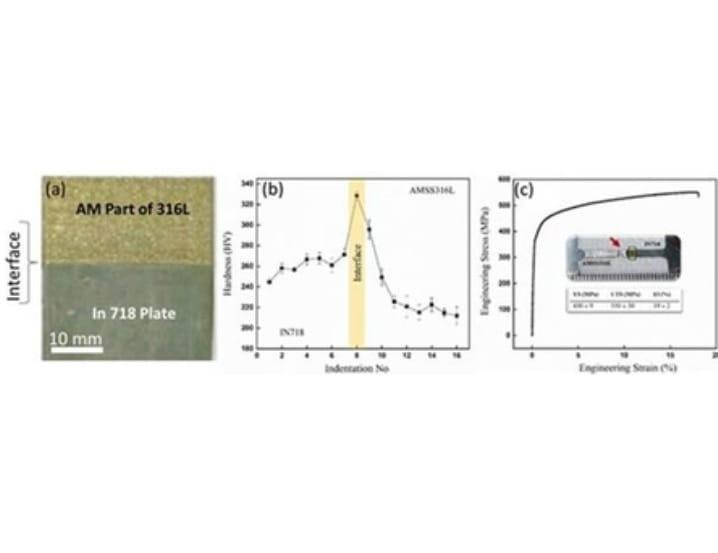
The breakthrough uses a laser-based powder bed fusion additive manufacturing process to successfully combine stainless steel (SS316L) with the nickel-based superalloy Inconel 718 (IN718). The innovation allows engineers to use costly superalloys only in sections exposed to extreme heat, while employing stainless steel in less demanding areas, reducing material costs without compromising performance.
Stainless steel is valued for its toughness and corrosion resistance, whereas Inconel 718 is known for its exceptional strength and resistance to high temperatures. Combining the two materials in a single component has long been a challenge because of differences in their chemical composition, melting points and thermal expansion rates, which often result in cracks, porosity and brittle intermetallic compounds during conventional welding.

Using laser-based additive manufacturing, the ARCI team successfully fabricated SS316L directly onto a surface-prepared IN718 plate, producing a defect-free interface with no visible cracks or porosity. The bi-metallic structure achieved a peak hardness of nearly 310 HV at the interface and an ultimate tensile strength of 550 ± 30 MPa. During testing, failure occurred in the softer stainless steel section rather than at the joint, demonstrating the strength and integrity of the interface.
The research, conducted by S. Narayanaswamy, Gururaj Telasang, Nokeun Park and Ravi Bathe, has been published in the journal Progress in Additive Manufacturing.
The technology has the potential to transform the manufacturing of multi-material components used in demanding industrial environments. It could be applied in boiler tubes, heat exchangers for nuclear and ultra-supercritical thermal power plants, advanced energy systems, nuclear reactors, and the oil and gas industry, where components require both high-temperature strength and excellent corrosion resistance.
In the aerospace sector, the technology could enable components with steel used for structural load-bearing sections and Inconel reserved for areas exposed to extreme temperatures. Additive manufacturing also makes it possible to create complex internal structures, allowing strategic placement of superalloys only where they are needed, improving performance while lowering manufacturing costs.
With inputs from IANS




| 14-09-2018 | ||||||
| Sl No. | Parameters | Actual Data(µg/m3) | Standard Limit(µg/m3) |
|---|---|---|---|
| 1 | PM 10 | 64 | 100 |
| 2 | PM 2.5 | 33 | 60 |
| 3 | SO2 | 55.3 | 80 |
| 4 | NO2 | 58.2 | 80 |
| 14-09-2018 | ||||||
| Station | Temperature(degree centigrade) | Rainfall(mm) | Relative humidity(%) | |||
|---|---|---|---|---|---|---|
| Max | Min | Past 24 hrs. | Since 1st March, 2018 | Max | Min | |
| Ranchi | 31.0 | 22.5 | 000.0 | 1010.1 | 95 | 66 |
| Jamshedpur | 34.1 | 26.2 | 000.0 | 1252.8 | 87 | 58 |
| Bokaro | 33.5 | 24.6 | 015.2 | 824.0 | 92 | 79 |
| Daltonganj | 32.6 | 24.9 | 004.2 | 960.9 | 95 | 67 |
© Copyright
Reporter Post.All Rights Reserved |
Powered by: Aptilogic Software |
 |
Page rendered in 0.087 seconds.
|
Page rendered in 0.087 seconds.