Thu, June 04, 2026
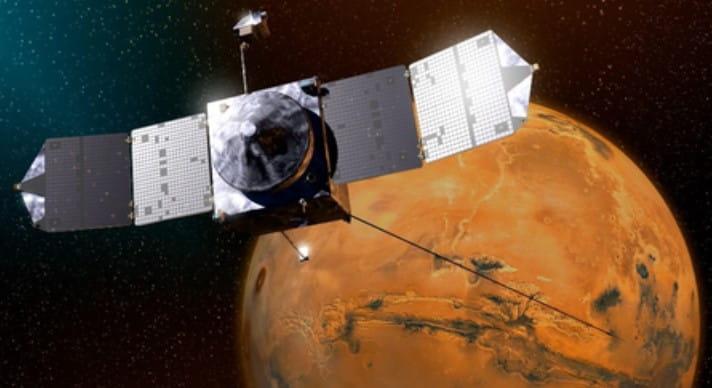
Los Angeles: NASA has officially ended its pioneering Mars Atmosphere and Volatile Evolution (MAVEN) mission after determining that the spacecraft, which lost contact with Earth in December 2025, cannot be recovered.
Launched on November 18, 2013, MAVEN entered orbit around Mars on September 21, 2014, becoming NASA’s first mission dedicated to studying the Red Planet’s atmosphere and how it has evolved over time. Although originally planned as a one-year mission, the spacecraft far exceeded expectations, operating successfully for more than 11 years.
NASA last received a signal from MAVEN on December 6, 2025, shortly after the spacecraft passed behind Mars. Following the communication loss, the agency established an anomaly review board in February to investigate the incident and evaluate the possibility of restoring contact.
After months of analysis, the review board concluded that the spacecraft is no longer recoverable and cannot continue its scientific research or communications relay functions. According to preliminary findings, MAVEN likely entered a rapid, uncontrolled spin after passing behind Mars. The rotation disrupted its orbital path and depleted its batteries, eventually shutting down its communication systems and severing contact with Earth.
While the exact cause of the anomaly is still under investigation, NASA expects to release a final report later this year.
The agency has now begun the formal decommissioning process and will archive the mission’s extensive scientific data for future use by researchers and exploration teams.
Over its decade-long journey, MAVEN provided critical insights into how Mars lost much of its atmosphere, helping scientists better understand the planet’s climate history and habitability. The mission’s findings are also expected to play an important role in planning future human missions to Mars.
Louise Prockter, Director of NASA’s Planetary Science Division, said the data gathered by MAVEN has been invaluable in assessing radiation risks and developing safety measures that will be essential before astronauts can safely travel to and operate on Mars.
With inputs from IANS




| 14-09-2018 | ||||||
| Sl No. | Parameters | Actual Data(µg/m3) | Standard Limit(µg/m3) |
|---|---|---|---|
| 1 | PM 10 | 64 | 100 |
| 2 | PM 2.5 | 33 | 60 |
| 3 | SO2 | 55.3 | 80 |
| 4 | NO2 | 58.2 | 80 |
| 14-09-2018 | ||||||
| Station | Temperature(degree centigrade) | Rainfall(mm) | Relative humidity(%) | |||
|---|---|---|---|---|---|---|
| Max | Min | Past 24 hrs. | Since 1st March, 2018 | Max | Min | |
| Ranchi | 31.0 | 22.5 | 000.0 | 1010.1 | 95 | 66 |
| Jamshedpur | 34.1 | 26.2 | 000.0 | 1252.8 | 87 | 58 |
| Bokaro | 33.5 | 24.6 | 015.2 | 824.0 | 92 | 79 |
| Daltonganj | 32.6 | 24.9 | 004.2 | 960.9 | 95 | 67 |
© Copyright
Reporter Post.All Rights Reserved |
Powered by: Aptilogic Software |
 |
Page rendered in 0.1085 seconds.
|
Page rendered in 0.1085 seconds.