Mon, April 20, 2026

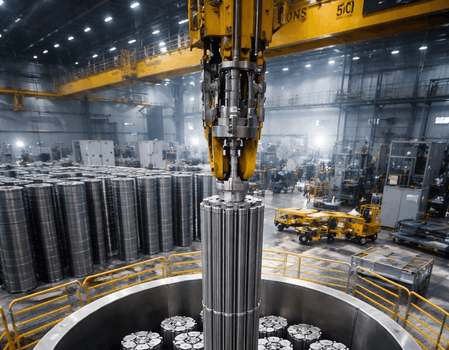
New Delhi — India appears to be edging closer to long-term nuclear self-reliance after achieving a significant milestone in its ambitious three-stage nuclear programme, according to a report.
An article in Vietnam Times describes the development as a potential turning point in India’s decades-old effort to overcome fuel limitations and build a sustainable nuclear energy ecosystem.
For years, India has faced a structural challenge — limited domestic uranium reserves, which are essential for most conventional nuclear reactors. Despite agreements with countries like Canada, the country still relies partly on imports. However, India holds nearly a quarter of the world’s thorium reserves, a resource that could transform its nuclear future if effectively harnessed.
The challenge, as the report explains, is that thorium cannot be used directly as nuclear fuel. It must first be converted into a usable form, which requires a complex, long-term technological pathway. This is where the vision of Homi J. Bhabha becomes crucial. Instead of seeking quick fixes, Bhabha proposed a three-stage programme designed to gradually transition India from uranium dependence to thorium-based self-reliance.
This strategy begins with uranium-fuelled reactors, moves to plutonium production, and ultimately aims to unlock thorium as a primary fuel source. For decades, progress in the second stage remained slow — until now.
On April 6, India’s Prototype Fast Breeder Reactor (PFBR) at Kalpakkam achieved “criticality” for the first time — a key moment when a reactor becomes self-sustaining. The milestone signals that India has successfully taken a major step into the second stage of its nuclear roadmap.
While fast breeder reactor programmes in several countries have struggled, the report notes that India’s persistence has paid off. These reactors are particularly important because they can generate more fissile material than they consume, effectively expanding the country’s nuclear fuel reserves over time.
The PFBR uses advanced technologies such as mixed oxide (MOX) fuel and liquid sodium cooling — systems that demand extremely high levels of precision, safety, and engineering control.
Despite the progress, challenges remain. Nuclear energy currently contributes just over 3% of India’s electricity generation, and scaling up will require sustained effort, investment, and regulatory oversight.
Still, the report concludes that India may finally be on the path envisioned decades ago — one where it can rely on its own resources, especially thorium, to secure its long-term energy needs rather than depending heavily on imported fuel.
With inputs from IANS




| 14-09-2018 | ||||||
| Sl No. | Parameters | Actual Data(µg/m3) | Standard Limit(µg/m3) |
|---|---|---|---|
| 1 | PM 10 | 64 | 100 |
| 2 | PM 2.5 | 33 | 60 |
| 3 | SO2 | 55.3 | 80 |
| 4 | NO2 | 58.2 | 80 |
| 14-09-2018 | ||||||
| Station | Temperature(degree centigrade) | Rainfall(mm) | Relative humidity(%) | |||
|---|---|---|---|---|---|---|
| Max | Min | Past 24 hrs. | Since 1st March, 2018 | Max | Min | |
| Ranchi | 31.0 | 22.5 | 000.0 | 1010.1 | 95 | 66 |
| Jamshedpur | 34.1 | 26.2 | 000.0 | 1252.8 | 87 | 58 |
| Bokaro | 33.5 | 24.6 | 015.2 | 824.0 | 92 | 79 |
| Daltonganj | 32.6 | 24.9 | 004.2 | 960.9 | 95 | 67 |
© Copyright
Reporter Post.All Rights Reserved |
Powered by: Aptilogic Software |
 |
Page rendered in 0.077 seconds.
|
Page rendered in 0.077 seconds.