Sat, October 03, 2026

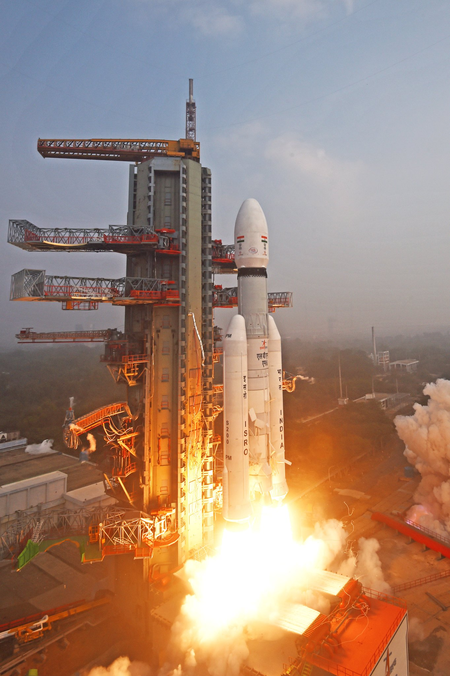
New Delhi: The Indian Space Research Organisation (ISRO) on Wednesday successfully launched BlueBird-6, the heaviest satellite ever carried by India, aboard its powerful ‘Baahubali’ Launch Vehicle Mark-3 (LVM3)-M6 rocket.
The next-generation communications satellite, developed by US-based company AST SpaceMobile, lifted off at 8:55 a.m. after a 24-hour countdown from the second launch pad at Sriharikota, around 135 km east of Chennai.
Following a flight of nearly 15 minutes, the BlueBird Block-2 spacecraft separated from the rocket and was precisely injected into its designated low Earth orbit at an altitude of about 520 km.
This marks the second satellite collaboration between ISRO and the US this year. Earlier in July, ISRO had successfully launched the $1.5-billion NASA-ISRO Synthetic Aperture Radar (NISAR) mission, designed to capture high-resolution images of Earth with the ability to penetrate fog, dense clouds, and ice layers.
Announcing the success of the mission, ISRO Chairman Dr. V. Narayanan said, “I am extremely happy to announce that the LVM3 Baahubali M6 launch vehicle has successfully and accurately injected the BlueBird Block-2 communication satellite into the intended orbit.”
“This is our 104th launch from Sriharikota. The LVM3 has now demonstrated 100 per cent mission success. We also achieved a rare milestone by executing back-to-back LVM3 missions within just 52 days, following the previous launch on November 2,” he added.
Weighing 6,100 kg, BlueBird-6 is the heaviest payload ever placed into low Earth orbit by the LVM3. The previous record-holder was the LVM3-M5 Communication Satellite-03, weighing around 4,400 kg, which was launched into geosynchronous transfer orbit earlier this month.
BlueBird-6 is part of AST SpaceMobile’s BlueBird Block-2 satellite constellation, designed to deliver space-based cellular broadband services directly to standard mobile smartphones. The company had earlier launched five satellites—BlueBird 1 to 5—in September 2024 and has partnerships with over 50 mobile network operators worldwide to expand global coverage.
The mission also represents the sixth operational flight of the LVM3 rocket and a major advancement in telecommunications technology, enabling high-speed 4G and 5G connectivity directly from space to mobile devices.
Developed by ISRO, the LVM3 is a three-stage heavy-lift launch vehicle consisting of two solid strap-on boosters (S200), a liquid core stage (L110), and a cryogenic upper stage (C25).
The launch was conducted under a commercial agreement between NewSpace India Ltd (NSIL), ISRO’s commercial arm, and US-based AST SpaceMobile (AST and Science, LLC).
Previously, the LVM3 has successfully carried out landmark missions including Chandrayaan-2, Chandrayaan-3, and two OneWeb missions that deployed a total of 72 satellites.
With inputs from IANS



© Copyright
Reporter Post.All Rights Reserved |
Powered by: Aptilogic Software |
 |
Page rendered in 0.0112 seconds.
|
Page rendered in 0.0112 seconds.