Wed, October 14, 2026

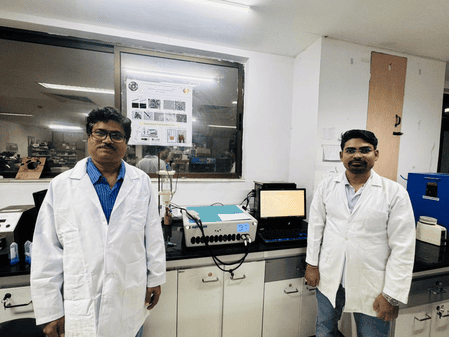
Researchers at the Indian Institute of Technology (IIT) Guwahati have developed a new corrosion-resistant epoxy coating designed to protect steel structures exposed to seawater and high-salinity environments.
Corrosion, a natural process that deteriorates metal over time, poses a major threat to offshore platforms, coastal bridges, port facilities, and marine pipelines. It weakens structural integrity, increases maintenance costs, and can cause environmental harm affecting both human and aquatic life.
While conventional barrier coatings are widely used, they often develop microscopic defects that allow moisture and salt ions to penetrate, ultimately damaging the metal beneath. To overcome this limitation, IIT Guwahati researchers created a novel nanocomposite by combining reduced graphene oxide (RGO), zinc oxide (ZnO), and polyaniline (PANI) in a single epoxy formulation.
The team achieved this by attaching zinc oxide nanorods to reduced graphene oxide sheets and then wrapping the structure with polyaniline. This composite was mixed into an epoxy coating and tested through various characterisation techniques.
Compared to standard epoxy coatings, the new formulation produced a denser and more uniform protective layer, enhanced adhesion to steel surfaces, and significantly slowed the movement of corrosive elements. These improvements make it promising for use in marine infrastructure, offshore oil and gas platforms, shipbuilding, coastal pipelines, and other steel installations exposed to harsh saltwater conditions.
“The incorporation of RGO-ZnO-PANI nanocomposite into epoxy coating offers a promising strategy for achieving long-term corrosion resistance in harsh marine environments. As the next step, we are working towards assessing the long-term durability, real-world performance, and life-cycle impact of this coating,” said Prof. Chandan Das.
Published in the journal Advanced Engineering Materials, the study contributes to ongoing research on corrosion-resistant materials and aims to enhance the longevity and reliability of structures operating in marine and high-salinity regions.
The researchers emphasized that the work is still at the laboratory stage and requires further validation before commercial use.
With inputs from IANS



© Copyright
Reporter Post.All Rights Reserved |
Powered by: Aptilogic Software |
 |
Page rendered in 0.012 seconds.
|
Page rendered in 0.012 seconds.