Fri, September 04, 2026

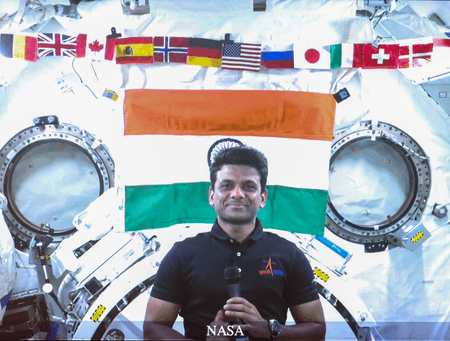
New Delhi — IAF Group Captain Shubhanshu Shukla is spearheading a crucial experiment aimed at understanding muscle health in space — a breakthrough with potential benefits for astronauts on long-duration missions and people on Earth suffering from muscle loss.
Shukla recently made history by becoming the first Indian to reach the International Space Station (ISS) as part of Axiom Space’s Ax-4 mission. He is working alongside crew members from the US, Poland, and Hungary, as well as seven astronauts from Expedition 73, focusing on research related to muscle and brain health.
“Shukla worked inside Kibo’s Life Science Glovebox, examining muscle stem cell cultures to study how muscle health can be preserved in space,” NASA revealed in a blog post.
Muscle deterioration in microgravity is a well-known challenge for space missions. The absence of gravity reduces mechanical load on muscles, causing them to weaken over time — a problem that has significant implications for both astronauts and individuals suffering from muscle-wasting conditions on Earth.
Explaining his experiment during an interaction with Prime Minister Narendra Modi from the ISS, Shukla said, “When we go to space, due to the lack of gravity, the muscles lose their load and begin to weaken. My experiment is testing whether we can prevent or slow down this muscle loss with the help of supplements.”
Shukla highlighted that the research has direct applications on Earth, particularly for older individuals who experience muscle deterioration due to aging. “These supplements could potentially help people dealing with age-related muscle loss,” he added.
Axiom Space emphasized the significance of the study, stating, “The findings could help prevent muscle atrophy in astronauts during extended space missions.” On Earth, this research could lead to new treatments for muscle-related diseases, conditions linked to aging, and muscle loss due to prolonged immobility, the company said.
In addition to his muscle health experiment, Shukla also recorded an educational video for young Indian students, explaining how the digestive system adapts to the space environment. He further documented crew activities for NASA’s Astronaut Mental Health study.
The Ax-4 crew’s 14-day mission aboard the ISS includes around 60 scientific and commercial experiments in microgravity, involving participants from 31 countries including India, the US, Poland, Hungary, Saudi Arabia, Brazil, Nigeria, the UAE, and several European nations.
India, through ISRO, has contributed seven carefully curated scientific studies to the mission.
With inputs from IANS



© Copyright
Reporter Post.All Rights Reserved |
Powered by: Aptilogic Software |
 |
Page rendered in 0.0789 seconds.
|
Page rendered in 0.0789 seconds.