
Sun, October 11, 2026

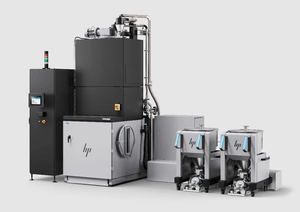
Representational Pic IANS
HP Inc on Monday unveiled HP Metal Jet, a new 3D printing technology designed to bring metal additive manufacturing into large-scale production and reshape the way industries manufacture complex metal components.
The company said HP Metal Jet can deliver productivity up to 50 times higher than conventional 3D metal printing methods while producing high-quality, mechanically functional parts at a lower cost. The technology is initially aimed at the automotive, industrial and medical sectors, which together manufacture billions of metal components every year.
“HP has helped lead the transformation by pioneering the 3D mass production of plastic parts and we are now doubling down with HP Metal Jet, a breakthrough metals 3D printing technology,” said Dion Weisler, CEO and President of HP Inc.
The technology will initially focus on stainless steel components. Through HP’s Metal Jet Production Service, customers were expected to be able to upload 3D design files and order industrial-grade metal parts in large quantities from the first half of 2019.
HP said commercial Metal Jet systems would be priced below $399,000. The company planned to begin shipping the systems to early customers in 2020, followed by wider availability in 2021.
A major part of HP’s strategy is its collaboration with established manufacturers. The company has partnered with UK-based GKN Powder Metallurgy to deploy Metal Jet in factories producing functional components for automotive and industrial customers, including Volkswagen and Wilo.
Peter Oberparleiter, CEO of GKN Powder Metallurgy, said the technology could open up manufacturing opportunities that had previously been too expensive to pursue.
Volkswagen is also evaluating HP Metal Jet as part of its long-term vehicle design and production plans. The technology could become particularly useful as automakers move toward electric vehicles, where reducing component weight can improve efficiency and range. It can also allow manufacturers to create certain parts without first investing in traditional production tooling.
“By 2025, the brands of Volkswagen Group will have introduced 80 new electric models,” said Dr Martin Goede, Head of Technology Planning and Development at Volkswagen. He highlighted the ability of additive manufacturing to produce components without the need to build manufacturing tools beforehand.
HP is also working with California-based Parmatech, an ATW company, to expand metal 3D printing for mass production. Parmatech plans to use HP Metal Jet to manufacture complex medical components, including surgical scissors and endoscopic surgical jaws.
The development marks a significant step in the evolution of 3D printing. While the technology has traditionally been associated with prototypes and small-batch production, HP is targeting high-volume manufacturing, potentially reducing tooling costs, shortening development cycles and allowing companies to produce more complex designs.



© Copyright
Reporter Post.All Rights Reserved |
Powered by: Aptilogic Software |
 |
Page rendered in 0.0115 seconds.
|
Page rendered in 0.0115 seconds.