Sun, October 11, 2026

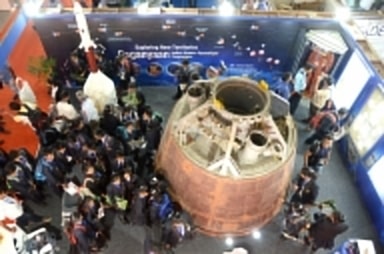
School students during an exhibition at the 6th Bengaluru Space Expo (BSX) 2018, in Bengaluru on Sept 6, 2018. (Photo: IANS)
A crew module developed by the Indian Space Research Organisation (ISRO) has emerged as one of the biggest attractions at the 6th Bengaluru Space Expo, offering visitors a close look at the technology that is expected to play a crucial role in India's human spaceflight programme.
The capsule on display was used in an unmanned experimental mission in 2014 and was subsequently recovered, demonstrating key technologies required for safely bringing a spacecraft and its occupants back to Earth.
“An unmanned crew capsule that can accommodate up to three astronauts and was tested in 2014 to orbit around the Earth has been exhibited at the space expo for visitors to view,” an ISRO official told IANS.
A similar crew module is planned for India's maiden human spaceflight mission, Gaganyaan. The module will serve as the living space and control centre for the astronauts during their journey into space.
The capsule has been showcased at ISRO's pavilion at the three-day exhibition being held at the Bengaluru International Exhibition Centre. It has attracted considerable attention from visitors, particularly students interested in India's growing space programme.
Hundreds of school students and other visitors have been visiting the pavilion to see the crew module and a model of the indigenously developed spacesuit that Indian astronauts will wear during the Gaganyaan mission.
The display provides visitors with a glimpse into the technological preparations behind India's ambition to send humans into space. The Gaganyaan programme involves the development and testing of several critical systems, including the crew module, life-support systems, astronaut suits and technologies required to safely return the crew to Earth.
The 2014 crew module test was an important early step in this effort, helping ISRO gain experience in atmospheric re-entry and recovery technologies that are essential for a human spaceflight mission.

The recovered capsule, made of heat protecting tiles, was launched aboard a Geosynchronous Satellite Launch Vehicle (GSLV) Mk III to re-enter the planet -- surviving temperatures as high as 1,500 degrees Celsius.
The exhibition has also featured pavilions dedicated to student-made satellites and launchers, space start-ups from across the country, and space agencies from countries including Russia, France and Taiwan.
The French National Centre for Space Studies (CNES), Russian space agency's launch service provider Glavkosmos and Taiwan's National Space Organisation (NSPO) were among the space agencies that showcased the satellites and launchers.
Space food packed for Russian cosmonauts put on display by the Glavkosmos also caught the visitors' attention.
The biennial space expo, touted to be the largest space conference in Asia, is being held from September 6-8, with the participation of over 100 exhibitors, space agency representatives and delegates from the US, the UK, France, Russia, and Taiwan, among other countries.



© Copyright
Reporter Post.All Rights Reserved |
Powered by: Aptilogic Software |
 |
Page rendered in 0.0131 seconds.
|
Page rendered in 0.0131 seconds.