Fri, September 25, 2026

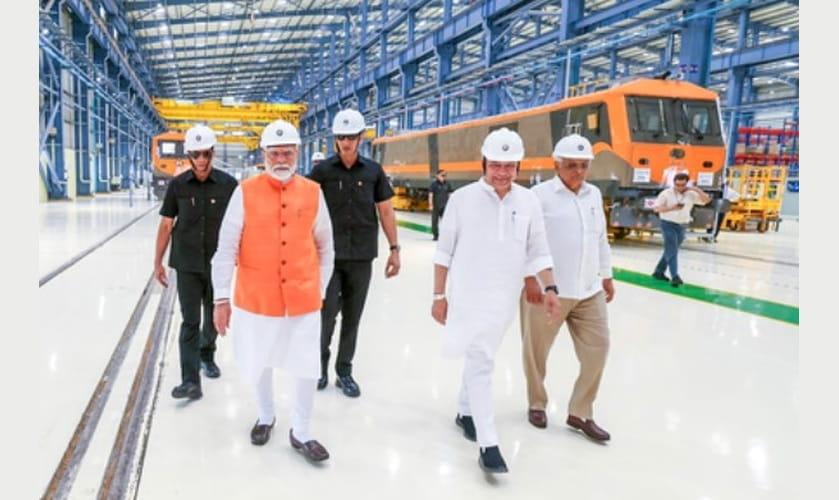
Photo: IANS
Prime Minister Narendra Modi on Friday highlighted the expansion of India’s manufacturing and export sectors as the Make in India initiative completed 12 years, pointing to higher domestic production, increased investment and rising exports across several industries.
In a post on X, Modi said the initiative had resulted in “more made in India, more investment in India and more exports from India”, adding that the transformation was visible across sectors.
Launched on September 25, 2014, Make in India was aimed at positioning India as a global hub for manufacturing, design and innovation. Under Make in India 2.0, the initiative now covers 27 sectors, including 15 manufacturing and 12 services sectors.
Electronics manufacturing has emerged as one of the most significant areas of expansion. Government data shows that electronics production increased nearly sevenfold from around Rs 1.9 lakh crore in 2014-15 to Rs 13.11 lakh crore in 2025-26. Electronics exports also rose from around Rs 38,000 crore to Rs 4.24 lakh crore during the same period.
Mobile-phone production recorded an even sharper increase, rising from about Rs 18,000 crore in 2014-15 to Rs 6.27 lakh crore in 2025-26. India is now the world's second-largest mobile phone manufacturer by volume, according to the government.
The defence sector has also recorded substantial growth in domestic production. Indigenous defence production reached a record Rs 1.78 lakh crore in 2025-26, compared with Rs 46,000 crore in 2014-15. Defence exports also reached a record Rs 38,424 crore in 2025-26, according to the Ministry of Defence.
The automobile industry has expanded as well. Vehicle production reached 31.03 million units in 2024-25, around 33 per cent higher than the level recorded in 2014-15, according to the government factsheet.
India's pharmaceutical industry currently ranks third globally by volume and 11th by value. Its annual turnover reached Rs 4,71,898 crore in 2024-25, while domestic medical-device manufacturing increased from Rs 28,000 crore in 2019-20 to Rs 41,500 crore in 2024-25.
The broader manufacturing sector has also shown recent momentum. According to the government, manufacturing GVA recorded a compound annual growth rate of 10.88 per cent between 2022-23 and 2025-26 under the revised national accounts series.
The Make in India push has been accompanied by programmes such as the Production Linked Incentive scheme, the National Single Window System and PM GatiShakti, alongside measures aimed at improving the investment climate and expanding domestic manufacturing capacity. The PLI schemes across 14 sectors have attracted more than Rs 2.16 lakh crore in investment and generated production worth Rs 20.41 lakh crore, according to government data.
Earlier in the day, Modi interacted with participants of the Seva Yatra travelling from Varanasi to Vadnagar under the Seva Sankalp Abhiyan. He called for greater self-reliance and said challenges should be addressed with determination and a spirit of service.
“We have to make a self-reliant India. Challenges will come. But we carry the values and mindset to challenge those challenges directly,” he said, while emphasising the principle of service to the people and the nation.
Twelve years after its launch, Make in India has therefore evolved beyond its original manufacturing-focused pitch into a broader policy framework encompassing domestic production, investment, exports, technology and supply-chain development.



© Copyright
Reporter Post.All Rights Reserved |
Powered by: Aptilogic Software |
 |
Page rendered in 0.011 seconds.
|
Page rendered in 0.011 seconds.