Tue, October 20, 2026


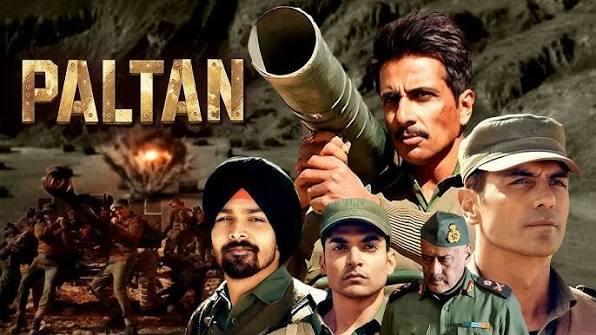
Film: Paltan
Director: J.P. Dutta
Starring: Arjun Rampal, Harshvardhan Rane, Gurmeet Chowdhary
Rating: 2/5
J.P. Dutta returns to the territory he knows best with Paltan, a war drama inspired by the Indian Army's confrontation with Chinese forces along the Sikkim border. But unlike Border, which created memorable emotional and patriotic moments, Paltan struggles to generate the same impact.
For much of its runtime, Paltan feels like a scaled-down version of Dutta's earlier LOC Kargil, only without the heavyweight star cast. While LOC featured actors such as Sanjay Dutt, Saif Ali Khan, Abhishek Bachchan and Nagarjuna, Paltan relies on Arjun Rampal, Harshvardhan Rane, Gurmeet Chowdhary and Luv Sinha to carry its military drama.
The film does have some visual strengths. Shot largely in warm, toasted-brown tones, Paltan gives its border setting an appropriately harsh and rugged appearance. Sanjoy Chowdhary's background score also manages to inject energy into several sequences, even when the dialogue becomes excessively theatrical.
Unfortunately, the songs do little to enhance the experience. Anu Malik's music sounds like recycled material from the composer's earlier collaborations with Dutta, particularly Border. The film badly misses the memorable melodies and emotional songs that once helped Dutta's war films connect with audiences.
The bigger problem is the treatment of patriotism. Instead of building tension through strategy, sacrifice and the psychological pressure faced by soldiers, the film repeatedly falls back on confrontations across the border. Indian and Chinese soldiers exchange insults and engage in childish physical confrontations, making some sequences resemble playground fights rather than a serious military standoff.
The Chinese soldiers, meanwhile, are presented largely as exaggerated caricatures. This approach weakens the film's credibility because a complex geopolitical and military conflict is reduced to a simple good-versus-bad equation.
There are moments when Dutta's filmmaking instincts still come through. The sequences showing soldiers moving across the border with rifles have an undeniable visual energy. But these moments are undermined by the repetition of territorial confrontations and similar skirmishes, eventually making the film feel longer and less purposeful than it needs to be.
Harshvardhan Rane brings considerable passion to his role as a hot-headed soldier driven by the memory of India's defeat to China in 1962. He gives the character the necessary intensity, although some of the physical-display sequences feel unnecessarily staged. Gurmeet Chowdhary also gets moments to showcase his physique rather than his acting.
Arjun Rampal and Jackie Shroff are capable performers who try to maintain some dignity amid the film's frequent overacting. The actors portraying the soldiers' wives and families, however, are pushed toward melodrama, particularly in scenes depicting the arrival of news about soldiers being killed.
One early sequence shows a postman delivering news of soldiers' deaths to families in a residential colony. The resulting cries of grief are so uniformly timed and exaggerated that the scene loses its emotional authenticity. Instead of feeling spontaneous, the sorrow comes across almost like a series of pre-recorded reactions.
The romantic flashbacks are no better. They often rely on clichés and awkward symbolism rather than developing the characters as people beyond their uniforms. One particularly odd sequence involving jaggery and a suggestion to move towards the fields feels completely disconnected from the seriousness of the surrounding narrative.
What makes Paltan disappointing is not the subject but the opportunity it misses. The 1967 Nathu La and Cho La clashes offered Dutta the material for a compelling story about military preparedness, courage, restraint and the consequences of conflict.
Instead of exploring why soldiers were forced into confrontation and what war actually costs the people involved, the film repeatedly celebrates confrontation itself.
Paltan could have been a thoughtful examination of a significant chapter in India's military history. It has the setting, the scale and the filmmaker's experience. But too often, it confuses loud patriotism with meaningful storytelling.
The result is a technically polished but emotionally uneven war drama that never reaches the power of Dutta's best work.




© Copyright
Reporter Post.All Rights Reserved |
Powered by: Aptilogic Software |
 |
Page rendered in 0.0086 seconds.
|
Page rendered in 0.0086 seconds.