Mon, July 06, 2026


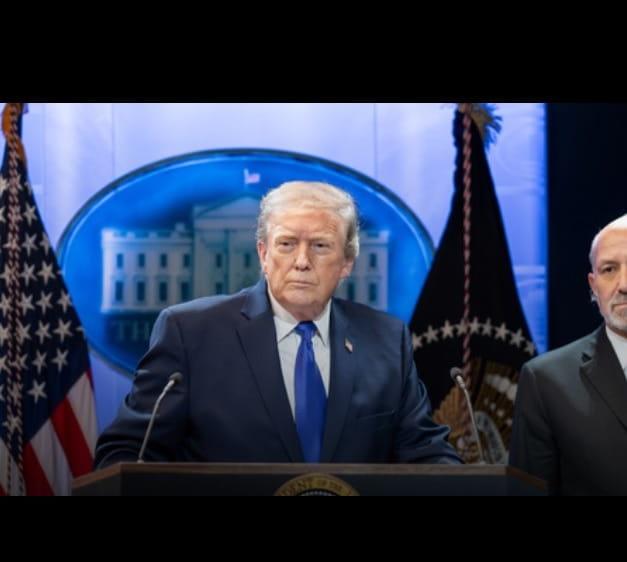
Washington- US President Donald Trump will travel to Ankara on Monday to attend the NATO summit, where defence spending, burden sharing and defence industry cooperation are expected to dominate discussions. During the visit, Trump is also scheduled to hold separate meetings with Turkish President Recep Tayyip Erdo?an, Ukrainian President Volodymyr Zelenskyy and Syrian President Ahmed al-Sharaa.
According to the White House, Trump will leave Washington on Monday evening and arrive in the Turkish capital on Tuesday afternoon. He will be welcomed by President Erdo?an with an official state arrival ceremony and honour guard before the two leaders hold bilateral talks.
Later on Tuesday, Trump will attend the NATO leaders' social dinner. On Wednesday, he will participate in the official welcome ceremony, family photograph and the NATO leaders' working session. He is also scheduled to meet Zelenskyy and Ahmed al-Sharaa before addressing a press conference and returning to Washington later that day.

US Ambassador to NATO Matthew G. Whitaker said the summit would review progress made by alliance members toward the defence spending commitments agreed at last year's NATO summit in The Hague, where member nations pledged to spend five per cent of their GDP on defence.
Whitaker said President Trump expects all allies to move quickly towards achieving the five per cent target, arguing that the current global security environment requires stronger and more capable partners.
He noted that NATO members have collectively committed nearly 139 billion US dollars in additional defence spending since the agreement, with about half of that amount being spent on American-made weapons, military equipment and ammunition.
While describing the progress as encouraging, Whitaker said some countries have advanced faster than others. He highlighted Poland, the Nordic nations and the Baltic states as leaders in boosting defence spending, while noting that Germany is expected to reach the target by 2029. He stressed that every NATO member should demonstrate a meaningful upward trajectory in defence investment.
Whitaker also emphasised the need to expand defence manufacturing capacity across North America and Europe to meet NATO's evolving capability requirements.
He said the United States remains committed to NATO but also faces strategic responsibilities in other parts of the world. Washington, he added, wants European allies and Canada to assume greater responsibility for the continent's conventional defence while strengthening the alliance's overall military capability.
White House spokesperson Anna Kelly said the administration views the Ankara summit as another milestone in reshaping NATO into an alliance based on greater self-reliance and fairer burden sharing among member states.
She added that leaders would also discuss defence procurement frameworks aimed at expanding military capabilities and creating more opportunities for American defence companies across NATO.
Senior administration officials said Trump's meeting with Zelenskyy will focus on efforts to end the Russia-Ukraine war. They described the frontline as having largely stabilised in recent months and said the President believes there is an urgent need to bring the conflict to an end and prevent further loss of life.
Officials also indicated that Trump is expected to speak with Russian President Vladimir Putin after his discussions with Zelenskyy.
On the sidelines of the summit, the administration expects announcements worth billions of dollars involving joint defence production projects, new manufacturing facilities and purchases of advanced American weapons systems.
According to US officials, the United States has sold around 50 billion US dollars worth of defence equipment to European and Canadian allies over the past year, while the American defence industry currently holds an order backlog of approximately 300 billion US dollars.
Officials also confirmed that the Pentagon is continuing its review of US troop deployments and military bases in Europe as part of a broader strategy to encourage European allies to play a larger role in defending the continent.
The summit takes place as NATO continues to adapt to Europe's changing security landscape following Russia's invasion of Ukraine. While many member countries have significantly increased defence spending in recent years, several allies are still working toward meeting the alliance's new defence investment commitments.
With inputs from IANS




| 14-09-2018 | ||||||
| Sl No. | Parameters | Actual Data(µg/m3) | Standard Limit(µg/m3) |
|---|---|---|---|
| 1 | PM 10 | 64 | 100 |
| 2 | PM 2.5 | 33 | 60 |
| 3 | SO2 | 55.3 | 80 |
| 4 | NO2 | 58.2 | 80 |
| 14-09-2018 | ||||||
| Station | Temperature(degree centigrade) | Rainfall(mm) | Relative humidity(%) | |||
|---|---|---|---|---|---|---|
| Max | Min | Past 24 hrs. | Since 1st March, 2018 | Max | Min | |
| Ranchi | 31.0 | 22.5 | 000.0 | 1010.1 | 95 | 66 |
| Jamshedpur | 34.1 | 26.2 | 000.0 | 1252.8 | 87 | 58 |
| Bokaro | 33.5 | 24.6 | 015.2 | 824.0 | 92 | 79 |
| Daltonganj | 32.6 | 24.9 | 004.2 | 960.9 | 95 | 67 |
© Copyright
Reporter Post.All Rights Reserved |
Powered by: Aptilogic Software |
 |
Page rendered in 0.0879 seconds.
|
Page rendered in 0.0879 seconds.