Sun, October 25, 2026

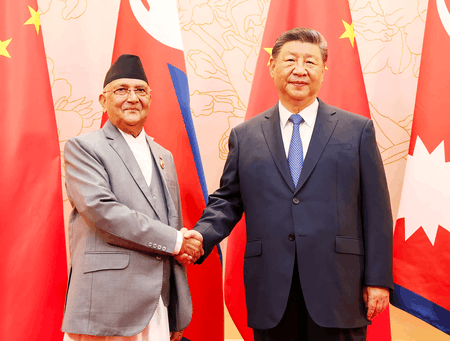
Kathmandu: Nepal’s new government has begun reviewing several infrastructure agreements signed with China, amid growing concerns over delays, execution gaps, and broader strategic implications.
According to an analysis by the Institute for Conflict Research and Resolution (ICRR), China’s engagement in Nepal has, in recent years, extended beyond economic cooperation into areas perceived as strategic and political influence. The report highlights instances of diplomatic pressure on issues such as Tibet and Taiwan, alongside concerns about Beijing’s expanding role in Nepal’s internal decision-making.
Many of these agreements were signed during the tenure of former Prime Minister K. P. Sharma Oli, when Nepal deepened ties with China under the Belt and Road Initiative (BRI). These projects were presented as transformative steps toward economic growth and connectivity, but several have since faced setbacks.
The current government in Kathmandu has launched a comprehensive review to determine why multiple China-linked projects have been stalled, delayed, or halted without clear justification. It has also announced that no new agreements with China will be signed until the review is completed.
Key projects under examination include:
The report also flags uneven progress in telecom and digital infrastructure projects involving Chinese tech firms like Huawei and ZTE, raising both execution and strategic concerns.
The review signals a cautious shift in Nepal’s approach toward China-backed initiatives, especially those linked to the Belt and Road Initiative. While the earlier government projected these projects as a pathway to transforming Nepal into a regional connectivity hub, lack of financial clarity and implementation challenges have slowed progress.
The outcome of the review is expected to shape Nepal’s future infrastructure strategy and its engagement with external partners.
With inputs from IANS



© Copyright
Reporter Post.All Rights Reserved |
Powered by: Aptilogic Software |
 |
Page rendered in 0.013 seconds.
|
Page rendered in 0.013 seconds.