Sun, September 27, 2026
New Delhi — Former Indian Army Chief Manoj Mukund Naravane has said the government gave complete operational freedom to the armed forces during the 2020 India-China standoff, reflecting strong trust in the military’s judgment and capabilities.
In an interview, Gen Naravane addressed the controversy around his yet-to-be-published memoir Four Stars of Destiny, stating that no official copy of the book is currently in circulation and he himself has not seen a final version. His remarks came amid political claims, including those made by Rahul Gandhi, regarding its contents.
Discussing the broader issue, Naravane clarified that giving the Army freedom to act should be interpreted as a sign of confidence rather than concern. He emphasized that such autonomy is standard in military operations and reflects institutional trust between the government and armed forces.
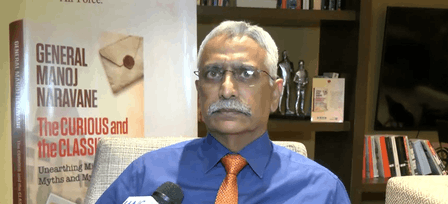
The former Army chief also spoke about his latest book, The Curious and the Classified: Unearthing Military Myths and Mysteries, which explores lesser-known aspects of military life and history through 25 anecdotal chapters. Among the topics covered are traditional war cries, including the popular phrase “Chak De Phatte,” which he traced back to Sikh military history.
Reiterating the Indian Army’s stance, Naravane stressed that the force remains firmly apolitical. He noted that following directives from elected leadership is part of the established chain of command and should not be misconstrued as political alignment.
On the 2020 standoff, he described India’s response as a “whole-of-nation effort,” involving coordination between political, diplomatic, and military channels. He asserted that the unified approach compelled Chinese forces to step back, calling it a significant achievement.
Commenting on evolving military strategy, Naravane pointed to operations like “Operation Sindoor” as marking a shift toward targeting higher-value objectives rather than just frontline threats. He added that such actions have strengthened deterrence.
Looking at global conflicts, including the Russia-Ukraine war and tensions in West Asia, he underlined the urgent need for India to become self-reliant across sectors—ranging from defense equipment to energy and essential supplies—highlighting that nations must be prepared to stand independently during crises.
He also noted that countries like Pakistan have historically leveraged global conflicts for strategic positioning, though such moves have often had mixed long-term outcomes.
With inputs from IANS


© Copyright
Reporter Post.All Rights Reserved |
Powered by: Aptilogic Software |
 |
Page rendered in 0.0084 seconds.
|
Page rendered in 0.0084 seconds.