Sun, September 27, 2026

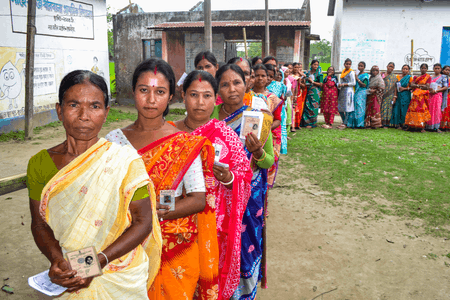
New Delhi — The Election Commission of India has confirmed that no re-poll will be held in either Tamil Nadu or West Bengal after completing a detailed scrutiny of voter registers and other election-day documents from the recent Assembly and by-elections.
The Commission said it followed a comprehensive post-poll verification process, including examination of the register of voters (Form 17A) and related records, to enhance transparency, identify any irregularities, and determine if re-polling was required.
In West Bengal, the scrutiny covered all 152 Assembly constituencies that voted in the first phase. The review was conducted by returning officers in the presence of general observers and more than 600 candidates or their representatives. All 1,478 candidates had been informed in advance about the schedule of the exercise. After reviewing records from 44,376 polling stations, no discrepancies warranting a re-poll were found. The second and final phase of voting in the state is scheduled for April 29.
A similar exercise was carried out in Tamil Nadu across all 234 constituencies, where polling was held in a single phase. The process involved 1,825 candidates or their representatives, with prior intimation given to all 4,023 candidates. Following scrutiny of records from 75,064 polling stations, the Commission reported no grounds for conducting a re-poll.
The ECI added that the entire verification process was videographed, and all examined documents were re-sealed under the supervision of returning officers. Electronic Voting Machines (EVMs) and VVPAT units have been secured in strong rooms under a double-lock system, with continuous surveillance and layered security.
Candidates have also been allowed to station representatives near the storage facilities to monitor security arrangements.
Voter participation remained notably high in both states. Tamil Nadu recorded around 85 percent turnout, while West Bengal saw over 92 percent polling in the first phase, despite isolated incidents of unrest—underscoring strong public engagement in the electoral process.
With inputs from IANS



© Copyright
Reporter Post.All Rights Reserved |
Powered by: Aptilogic Software |
 |
Page rendered in 0.0173 seconds.
|
Page rendered in 0.0173 seconds.