Sat, August 15, 2026






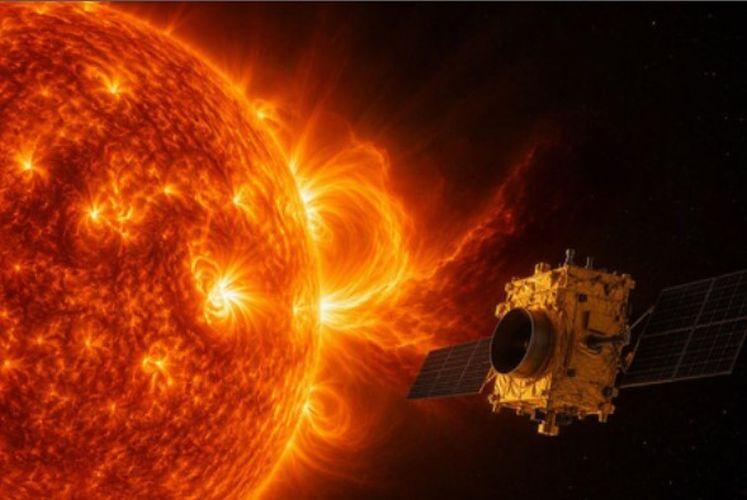
Photo: IANS
Data from India’s Aditya-L1 solar mission is helping scientists better understand one of the biggest unanswered questions in solar physics: why the Sun’s outer atmosphere, or corona, is far hotter than its visible surface.
Researchers studying observations from Aditya-L1, India’s first dedicated solar observation mission, have reported findings that offer fresh clues about how the corona reaches extreme temperatures and continues to maintain its heat despite the enormous amount of energy released during solar eruptions.
The study, published in the Astrophysical Journal Letters, was led by Professor R. Ramesh of the Indian Institute of Astrophysics (IIA). The researchers examined solar observations to gain a better understanding of the processes responsible for heating the corona and restoring energy lost during powerful eruptions.
The temperature pattern of the Sun has puzzled scientists for decades. Its core reaches temperatures of nearly 15 million degrees Celsius, where nuclear fusion takes place. However, the visible surface, known as the photosphere, is much cooler, at around 5,500 degrees Celsius.



The real mystery begins farther out. Despite being much farther from the Sun’s core, the corona can reach temperatures of around 2 million degrees Celsius and, during particularly energetic events, can become as hot as 40 million degrees Celsius.
This extraordinary temperature difference — with the atmosphere becoming dramatically hotter above the relatively cool surface — is known as the coronal heating problem. Scientists have proposed several mechanisms over the years, but a complete explanation has remained elusive.
The corona is also the region from which some of the Sun’s most powerful eruptions originate, including solar flares and coronal mass ejections (CMEs). These events send huge quantities of energy, radiation and charged particles into space.
When such solar material reaches Earth, it can produce spectacular auroras. Powerful geomagnetic storms, however, can also interfere with satellites, navigation systems, radio communications and power infrastructure, making the study of solar activity important not only for astronomy but also for modern technology.
According to Prof. Ramesh, the Sun typically produces around two to three CMEs a day during periods of relatively low activity. During the peak of its roughly 11-year solar cycle, the frequency can increase to 10 or more eruptions a day.
This raises another important question: how does the corona maintain its extremely high temperature while repeatedly losing enormous amounts of energy through such eruptions?
The new Aditya-L1 observations provide scientists with additional evidence to investigate how energy is transported and deposited in the solar atmosphere. By studying these processes in greater detail, researchers hope to improve their understanding of how the corona is heated and how the Sun replenishes energy following major eruptions.
The findings also underline the importance of India’s growing capabilities in solar research. Positioned at the Sun-Earth L1 point, Aditya-L1 can continuously observe the Sun without the interruptions caused by Earth’s rotation, allowing scientists to monitor solar activity and study changes in the solar atmosphere over extended periods.
As the mission continues to collect observations, scientists expect Aditya-L1 to contribute further to understanding the mechanisms driving solar eruptions and the space-weather conditions that can ultimately affect Earth.





© Copyright
Reporter Post.All Rights Reserved |
Powered by: Aptilogic Software |
 |
Page rendered in 0.1016 seconds.
|
Page rendered in 0.1016 seconds.