
Thu, April 23, 2026

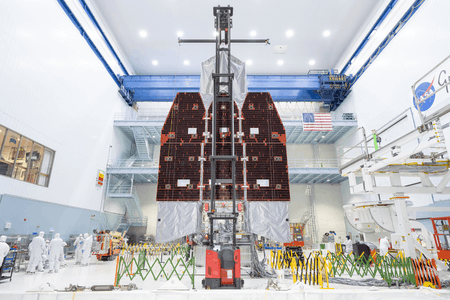
New Delhi: NASA has introduced the Nancy Grace Roman Space Telescope, a next-generation wide-field observatory designed to explore planets beyond our solar system and unlock the mysteries of dark matter and dark energy.
Speaking at the Goddard Space Flight Center, NASA administrator Jared Isaacman described the mission as a transformative step, saying Roman will provide “a new atlas of the universe.” The 12-metre-long telescope, equipped with expansive solar panels, is slated to be transported to Florida for launch aboard a SpaceX rocket, potentially as early as September.
Named after Nancy Grace Roman—often called the “mother of the Hubble Space Telescope”—the observatory boasts a field of view nearly 100 times wider than Hubble. Over its lifetime, it is expected to capture light from around a billion galaxies, dramatically expanding our cosmic map.
Roman’s advanced instruments will allow it to block out starlight and directly image exoplanets and planet-forming disks—something rarely achieved before. Scientists also plan to use it for a large-scale census of planetary systems across the Milky Way, while addressing fundamental questions in infrared astrophysics and the nature of dark energy.
Built over more than a decade at a cost exceeding $4 billion, the telescope will operate about 1.5 million kilometres from Earth at the Sun-Earth Lagrange Point L2. This location offers a stable gravitational environment and consistent thermal conditions, enabling significantly more precise observations—up to ten times better in some areas compared to Hubble.
According to NASA engineer Mark Melton, the observatory will transmit roughly 11 terabytes of data to Earth each day, underscoring the mission’s massive scientific output and potential to reshape our understanding of the universe.
With inputs from IANS




| 14-09-2018 | ||||||
| Sl No. | Parameters | Actual Data(µg/m3) | Standard Limit(µg/m3) |
|---|---|---|---|
| 1 | PM 10 | 64 | 100 |
| 2 | PM 2.5 | 33 | 60 |
| 3 | SO2 | 55.3 | 80 |
| 4 | NO2 | 58.2 | 80 |
| 14-09-2018 | ||||||
| Station | Temperature(degree centigrade) | Rainfall(mm) | Relative humidity(%) | |||
|---|---|---|---|---|---|---|
| Max | Min | Past 24 hrs. | Since 1st March, 2018 | Max | Min | |
| Ranchi | 31.0 | 22.5 | 000.0 | 1010.1 | 95 | 66 |
| Jamshedpur | 34.1 | 26.2 | 000.0 | 1252.8 | 87 | 58 |
| Bokaro | 33.5 | 24.6 | 015.2 | 824.0 | 92 | 79 |
| Daltonganj | 32.6 | 24.9 | 004.2 | 960.9 | 95 | 67 |
© Copyright
Reporter Post.All Rights Reserved |
Powered by: Aptilogic Software |
 |
Page rendered in 0.0223 seconds.
|
Page rendered in 0.0223 seconds.