Thu, October 15, 2026

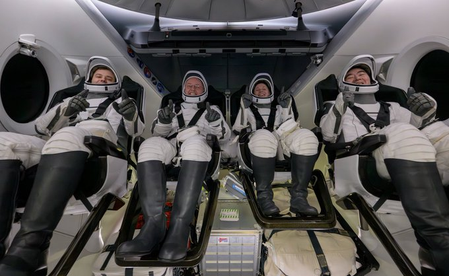
New Delhi: Elon Musk-led SpaceX on Thursday successfully returned four astronauts to Earth in the first-ever medical evacuation mission from the International Space Station (ISS), marking a significant milestone in human spaceflight safety.
NASA astronauts Zena Cardman and Mike Fincke, Japan Aerospace Exploration Agency (JAXA) astronaut Kimiya Yui, and Roscosmos cosmonaut Oleg Platonov landed safely at 12:41 a.m. PST (2:11 p.m. IST) aboard SpaceX’s Dragon spacecraft. The capsule splashed down off the coast of San Diego, California.
“Welcome home, Crew-11! At 3:41 a.m. ET (0841 UTC), the SpaceX Dragon spacecraft splashed down off the coast of San Diego, California,” NASA announced in a post on social media platform X. SpaceX also confirmed the successful return, stating that Dragon and NASA’s Crew-11 had safely returned to Earth.
The astronauts concluded a mission of over five months aboard the ISS. Their early departure leaves three crew members—NASA astronaut Chris Williams and Russian cosmonauts Sergey Kud-Sverchkov and Sergei Mikaev—currently on the space station. A new crew of four astronauts is scheduled to arrive next month.
NASA stated that all four returning crew members will be transported to a local hospital for further medical evaluation, allowing access to comprehensive medical resources on Earth to ensure optimal care.
Earlier, on January 8, NASA had postponed its first planned spacewalk of 2026 involving Fincke and Cardman due to a medical concern affecting one of the astronauts. The agency did not disclose further details, citing medical privacy, but confirmed that the situation was stable.
NASA Administrator Jared Isaacman said the Crew-11 return underscores the strength and flexibility of the US space programme. He commended the mission teams and crew for their accomplishments, noting that Crew-11 conducted more than 140 scientific experiments advancing human space exploration.
“Missions like Crew-11 demonstrate our ability to safely bring astronauts home when needed, rapidly launch new crews, and continue advancing human spaceflight as we prepare for historic missions such as Artemis II and future exploration of the Moon and Mars,” Isaacman said.
During their 167-day mission, the crew travelled nearly 71 million miles and completed more than 2,670 orbits around Earth. The mission marked the fourth spaceflight for Fincke, the second for Yui, and the first for Cardman and Platonov. Fincke has now logged a total of 549 days in space, ranking fourth among NASA astronauts in cumulative time spent in orbit.
With inputs from IANS



© Copyright
Reporter Post.All Rights Reserved |
Powered by: Aptilogic Software |
 |
Page rendered in 0.0102 seconds.
|
Page rendered in 0.0102 seconds.