Mon, July 06, 2026


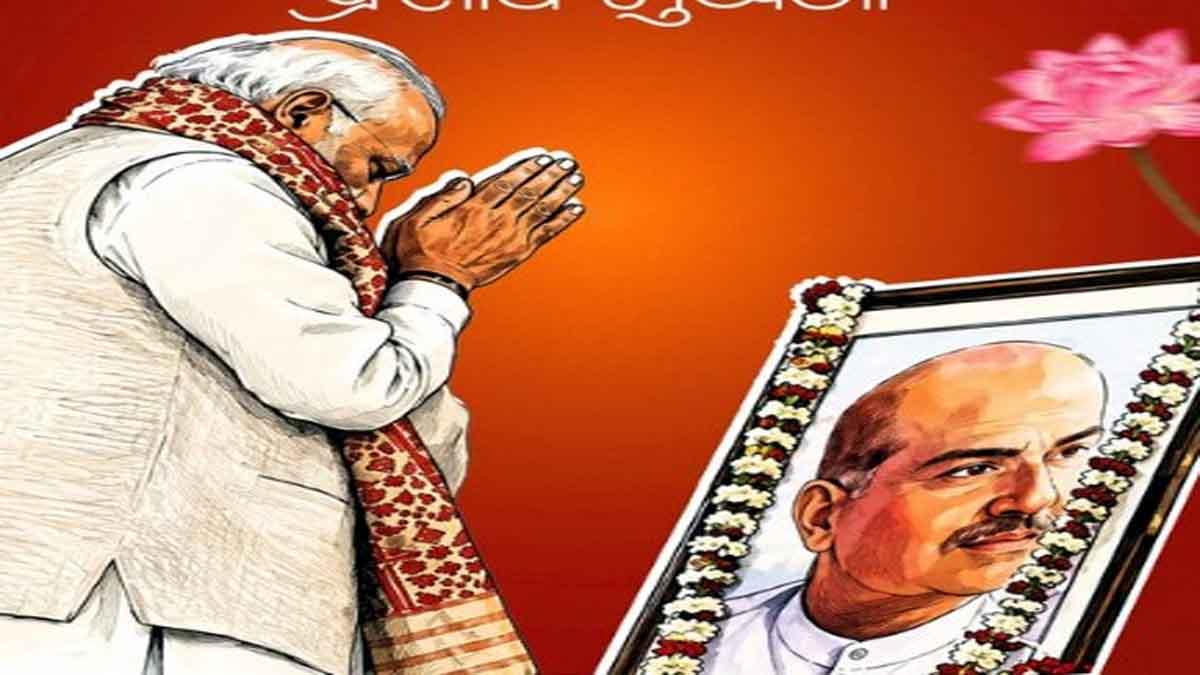
Gandhinagar: Gujarat Chief Minister Bhupendra Patel and Deputy Chief Minister Harsh Sanghavi on Monday shared Prime Minister Narendra Modi's article commemorating the 125th birth anniversary of Dr Syama Prasad Mookerjee, highlighting his ideals, public service and contributions to India's political and administrative history. In a post on social media platform X, CM Patel said Dr Mookerjee's ideals, thoughts and "unparalleled dedication to the nation" continue to inspire every Indian. Urging people to read the Prime Minister's article, he wrote: "Dr Mookerjee's ideals, his thoughts and his unparalleled dedication to the nation are a source of inspiration for every Indian. On the occasion of his 125th birth anniversary, do read this article by the Prime Minister Narendra Modi and learn about his inspiring life." Sanghavi also paid tribute to Dr Mookerjee and referred to the Prime Minister's article in his message on X. "Humble tributes to Dr Syama Prasad Mookerjee on his birth anniversary. He was a symbol of patriotism, unwavering resolve and a strong advocate of an undivided India," Sanghavi said. He added that the Prime Minister's special article described Dr Mookerjee's vision as independent India's first Industry Minister, his role in ensuring that Bengal remained an integral part of India, his opposition to Article 370 and "his supreme sacrifice", along with several of his other contributions. The Prime Minister's article, published to mark Dr Mookerjee's 125th birth anniversary, describes him as a leader whose public life was defined by the ideal of an indivisible India and portrays him as a mix of intellectual achievement, public service and moral conviction. PM Modi wrote that Dr Mookerjee played an important role during the Partition period in ensuring that West Bengal remained part of India, recalled his tenure as the country's first Industry Minister and highlighted his work in higher education, including as Vice-Chancellor of the University of Calcutta. The article also refers to Dr Mookerjee's opposition to the special constitutional status of the former state of Jammu and Kashmir and states that the abrogation of Articles 370 and 35A fulfilled a long-standing objective associated with his political campaign. Dr Mookerjee, born on July 6, 1901, was an educationist, parliamentarian and the founder of the Bharatiya Jana Sangh, the ideological predecessor of the Bharatiya Janata Party. He served as India's first Minister for Industry and Supply in Jawaharlal Nehru's Cabinet before resigning in 1950 over policy differences. He died in 1953 in jail after being detained in Jammu and Kashmir while protesting the state's permit system.





| 14-09-2018 | ||||||
| Sl No. | Parameters | Actual Data(µg/m3) | Standard Limit(µg/m3) |
|---|---|---|---|
| 1 | PM 10 | 64 | 100 |
| 2 | PM 2.5 | 33 | 60 |
| 3 | SO2 | 55.3 | 80 |
| 4 | NO2 | 58.2 | 80 |
| 14-09-2018 | ||||||
| Station | Temperature(degree centigrade) | Rainfall(mm) | Relative humidity(%) | |||
|---|---|---|---|---|---|---|
| Max | Min | Past 24 hrs. | Since 1st March, 2018 | Max | Min | |
| Ranchi | 31.0 | 22.5 | 000.0 | 1010.1 | 95 | 66 |
| Jamshedpur | 34.1 | 26.2 | 000.0 | 1252.8 | 87 | 58 |
| Bokaro | 33.5 | 24.6 | 015.2 | 824.0 | 92 | 79 |
| Daltonganj | 32.6 | 24.9 | 004.2 | 960.9 | 95 | 67 |
© Copyright
Reporter Post.All Rights Reserved |
Powered by: Aptilogic Software |
 |
Page rendered in 0.0837 seconds.
|
Page rendered in 0.0837 seconds.