Thu, October 15, 2026

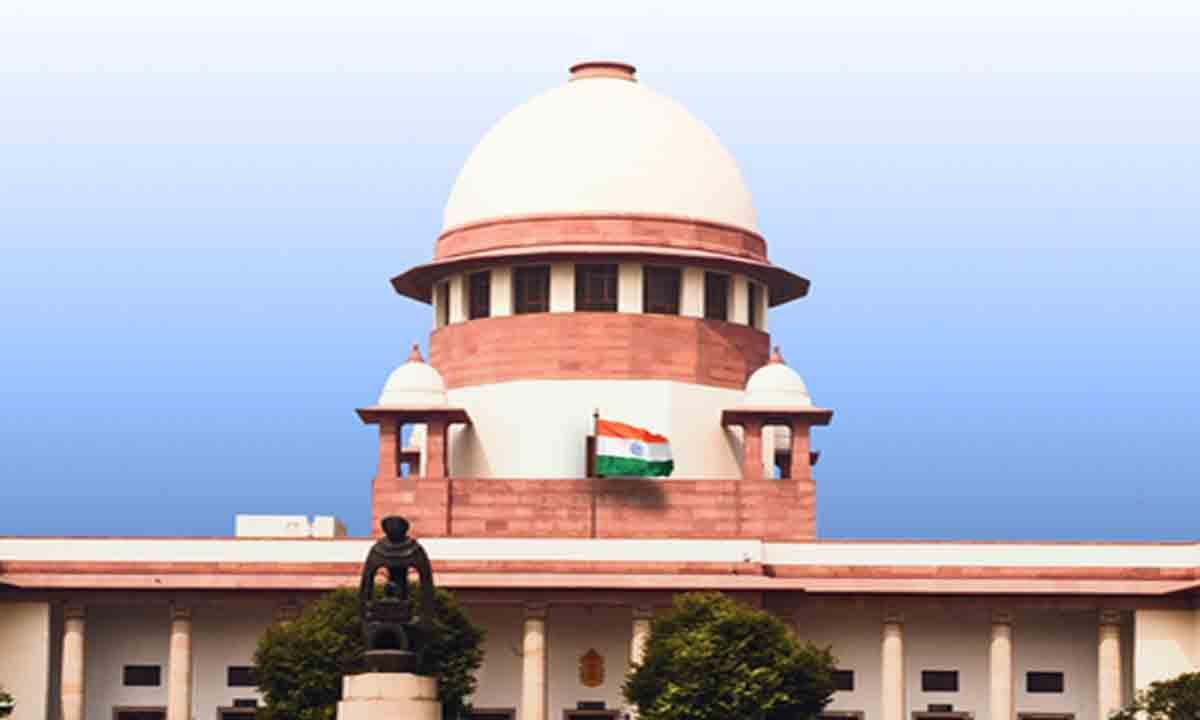
New Delhi: The Supreme Court on Tuesday declined to entertain a Public Interest Litigation (PIL) challenging the constitutional validity of the income-tax exemption granted to Scheduled Tribes residing in the North Eastern Region under the Income-Tax Act, 2025. Observing that the issue essentially concerned legislative policy, a Bench of Chief Justice of India (CJI) Surya Kant and Justice V. Mohana said the petitioner was at liberty to place his concerns before the competent authorities and Parliamentary committees entrusted with examining legislative reforms. "The grievance raised is essentially a legislative issue. Parliament has committees where every citizen can place suggestions for making or improving laws. We are sure the elected representatives are aware of these matters and will consider them," the CJI Kant-led Bench observed during the hearing. The writ petition, filed by advocate Ashwini Kumar Upadhyay, sought either the striking down of the tax exemption provision or, alternatively, the introduction of a "creamy layer" mechanism restricting the benefit to economically weaker Scheduled Tribe individuals. The plea challenged the constitutional validity of Section 11 read with Schedule III Serial No. 19 of the Income-Tax Act, 2025, contending that the provision grants a blanket income-tax exemption to Scheduled Tribes residing in notified areas of the North Eastern Region without any income ceiling, asset-based exclusion, creamy layer principle or periodic review mechanism. According to the petition, the exemption was originally conceived under Section 10(26) of the Income Tax Act, 1961 as a protective measure for tribal communities living in geographically isolated and economically underdeveloped regions. However, it argued that substantial infrastructural, educational and commercial development in the region over the past two decades had altered the factual circumstances that originally justified the classification. It argued that the continued operation of the exemption without any income ceiling, creamy layer exclusion, asset-based criteria or periodic review mechanism had become arbitrary and overinclusive. It further claimed that the blanket tax exemption created a structural disadvantage for non-exempt traders and professionals operating under similar economic conditions in the region. As an alternative to striking down the provision, the petitioner urged the Supreme Court to direct the Centre to introduce a “creamy layer” mechanism, proposing that Scheduled Tribe individuals earning above a prescribed annual income threshold should not be eligible for the exemption. The plea also sought the constitution of an expert committee to periodically review and recommend appropriate income thresholds for the tax benefit. However, the Supreme Court declined to examine the merits of the matter and left it open to the petitioner to pursue the matter before the competent legislative authorities.



© Copyright
Reporter Post.All Rights Reserved |
Powered by: Aptilogic Software |
 |
Page rendered in 0.0102 seconds.
|
Page rendered in 0.0102 seconds.