Tue, June 16, 2026





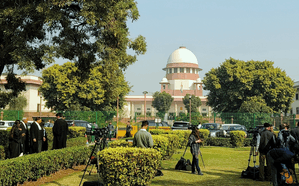
New Delhi- The Supreme Court on Tuesday agreed to examine a Public Interest Litigation (PIL) seeking directions to the Centre, all states and union territories, and the Election Commission of India (ECI) to ensure that Aadhaar is used strictly as proof of identity and not as evidence of citizenship, domicile, address or date of birth.
A Bench comprising Chief Justice of India Surya Kant and Justice V. Mohana issued notices to the Union government, all state governments and Union Territories, the Election Commission of India (ECI), and the Unique Identification Authority of India on a petition filed by advocate Ashwini Kumar Upadhyay.

The matter has been scheduled for further hearing on August 7.
The petition argues that Section 9 of the Aadhaar Act, 2016 clearly states that Aadhaar is not proof of citizenship or domicile. It further cites UIDAI notifications, which clarify that Aadhaar serves only as proof of identity and not as proof of citizenship, address or date of birth.
According to the plea, despite these legal provisions and court observations that Aadhaar is not proof of age, it continues to be widely accepted as evidence of age, residence, citizenship and domicile for various purposes, including school admissions, property transactions, issuance of birth certificates, ration cards and driving licences.
The PIL specifically challenges the use of Aadhaar as proof of date of birth and residence in the voter registration application form (Form-6), contending that such usage is contrary to the Aadhaar Act, UIDAI guidelines and provisions of the Representation of the People Act.
The petitioner has sought directions to the Centre, states and the ECI to ensure that Aadhaar is used only for identification purposes and not for purposes prohibited under the Aadhaar Act and UIDAI regulations.
Referring to the Aadhaar enrolment framework, the petition states that any resident, including foreign nationals who have lived in India for at least 182 days, can obtain an Aadhaar number. It further points out that enrolment can be facilitated through Common Service Centres using documents such as rent agreements or certifications issued by local authorities.
The plea alleges that illegal immigrants and infiltrators are able to obtain Aadhaar cards through weak verification mechanisms and subsequently use them as foundational documents to acquire other identity and entitlement documents, including ration cards, birth certificates, domicile certificates, driving licences and voter identity cards.
According to the petitioner, this undermines the integrity of the identification framework established under the Aadhaar Act and enables ineligible individuals to access subsidies, welfare schemes and benefits intended for legitimate beneficiaries.
The petition further argues that such practices may lead to diversion of public resources, exclusion of genuine beneficiaries and violations of constitutional principles relating to equality, fairness and targeted welfare delivery.
The petitioner said the cause of action arose from concerns over the alleged misuse of Aadhaar beyond its legally permissible purpose, despite repeated clarifications in the Aadhaar Act and UIDAI notifications regarding its limited evidentiary value.
Besides seeking strict adherence to Aadhaar's role as proof of identity, the petition also seeks a declaration that the use of Aadhaar as proof of date of birth and residence in voter registration processes is legally unsustainable and should be declared void and inoperative.
With inputs from IANS





| 14-09-2018 | ||||||
| Sl No. | Parameters | Actual Data(µg/m3) | Standard Limit(µg/m3) |
|---|---|---|---|
| 1 | PM 10 | 64 | 100 |
| 2 | PM 2.5 | 33 | 60 |
| 3 | SO2 | 55.3 | 80 |
| 4 | NO2 | 58.2 | 80 |
| 14-09-2018 | ||||||
| Station | Temperature(degree centigrade) | Rainfall(mm) | Relative humidity(%) | |||
|---|---|---|---|---|---|---|
| Max | Min | Past 24 hrs. | Since 1st March, 2018 | Max | Min | |
| Ranchi | 31.0 | 22.5 | 000.0 | 1010.1 | 95 | 66 |
| Jamshedpur | 34.1 | 26.2 | 000.0 | 1252.8 | 87 | 58 |
| Bokaro | 33.5 | 24.6 | 015.2 | 824.0 | 92 | 79 |
| Daltonganj | 32.6 | 24.9 | 004.2 | 960.9 | 95 | 67 |
© Copyright
Reporter Post.All Rights Reserved |
Powered by: Aptilogic Software |
 |
Page rendered in 0.0951 seconds.
|
Page rendered in 0.0951 seconds.