Fri, October 30, 2026

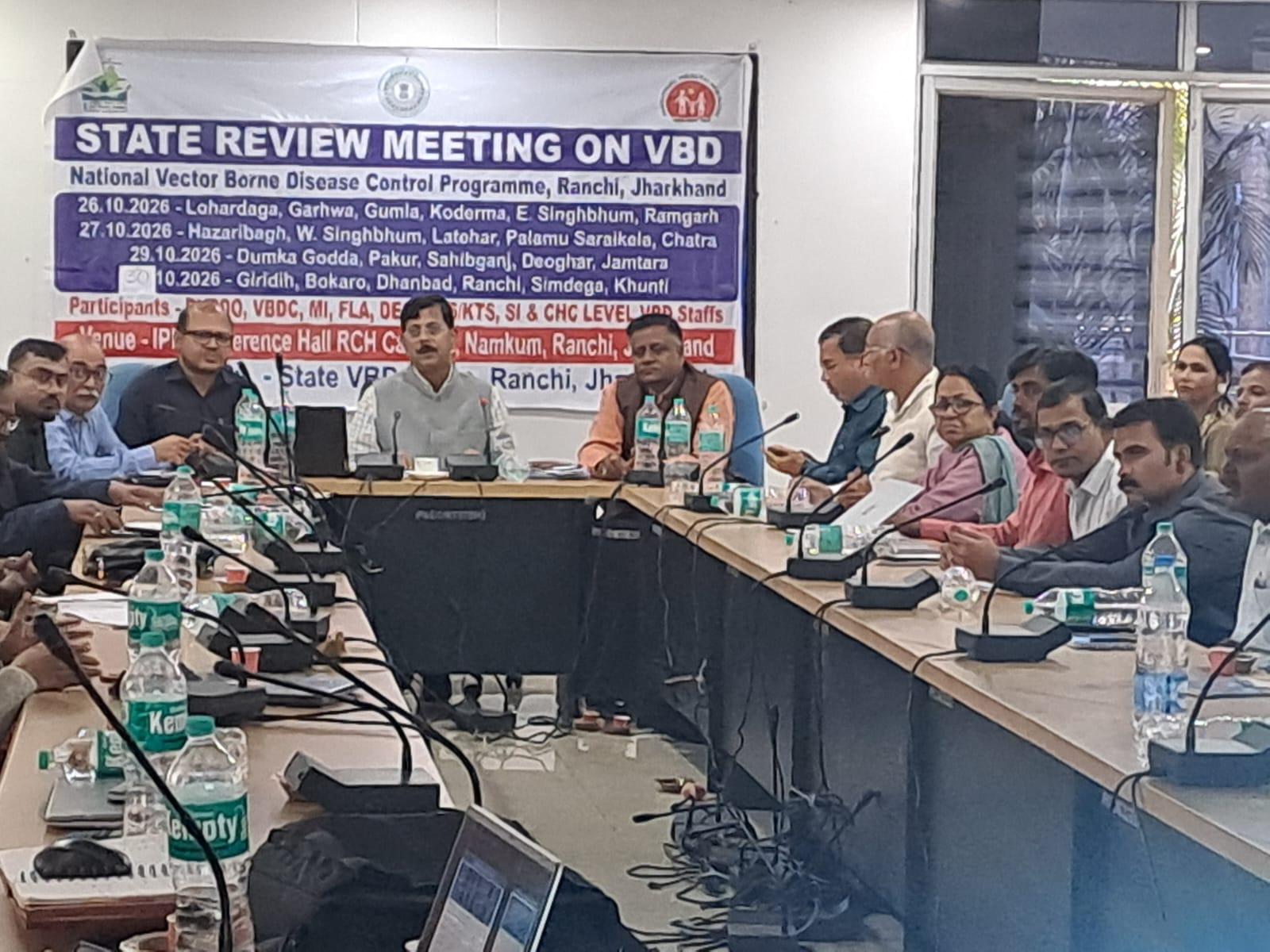
Ranchi, October 30: The Jharkhand Health Department has reviewed the implementation of its Vector-Borne Disease Control Programme, with a special focus on early detection, timely diagnosis and complete treatment of patients. A five-day review and orientation programme was held from October 26 to 30, 2026, at the Institute of Public Health, Namkum, Ranchi. The meeting was chaired by Shashi Prakash Jha, Mission Director of the National Health Mission (NHM), Jharkhand.
The programme was organised in line with the guidelines of the Government of India. Its objective was to strengthen disease-control activities and speed up efforts to eliminate malaria, filariasis, dengue, chikungunya, kala-azar and Japanese encephalitis from the state.
Officials and field-level representatives from all districts participated in the meeting. These included District Vector-Borne Disease Officers, VBD Consultants, Malaria Technical Supervisors, Kala-azar Technical Supervisors, Malaria Inspectors, Financial and Logistic Assistants, and Data Entry Operators.
During the review, participants discussed the difficulties being faced in implementing disease-control measures across different districts. Officials stressed the need to identify suspected cases at the earliest, ensure prompt diagnosis and provide patients with complete treatment without delay.
Addressing the participants, NHM Mission Director Shashi Prakash Jha called for stronger implementation of the programme at the village level. He asked officials and field workers to perform their duties with dedication and ensure better coordination. He also highlighted the importance of timely diagnosis, treatment, regular patient follow-ups and prompt payment of incentives to Sahiyas, who play a key role in community healthcare.
State Programme Officer Dr Ranjit Prasad underlined the importance of prevention in controlling vector-borne diseases. He advised that infected patients should sleep under insecticide-treated mosquito nets to prevent further transmission. He also stressed providing mosquito nets to their family members and gradually extending coverage to the wider community.
Dr Prasad further directed districts to ensure timely treatment of patients identified during the initial stage of filariasis. He also instructed them to organise hydrocele surgery camps twice a week by fixing two dedicated days for the procedures.
Meanwhile, Dr Rahul Kishore Singh, State Nodal Officer for Information, Education and Communication (IEC), explained that malaria spreads through the bite of an infected female Anopheles mosquito. He urged people to take precautions against mosquito bites and keep their surroundings clean. He also recommended regular use of insecticide-treated mosquito nets and wearing full-sleeved clothes, long trousers and socks, especially during the evening and night.
Representatives of the World Health Organization (WHO), Piramal Foundation and CINI also attended the programme, along with state-level officials, consultants and Malaria Inspectors.
The five-day meeting concluded with a renewed focus on coordination between departments, stronger field-level implementation and improved prevention, early diagnosis and complete treatment of vector-borne diseases across Jharkhand.


© Copyright
Reporter Post.All Rights Reserved |
Powered by: Aptilogic Software |
 |
Page rendered in 0.0136 seconds.