Thu, October 08, 2026

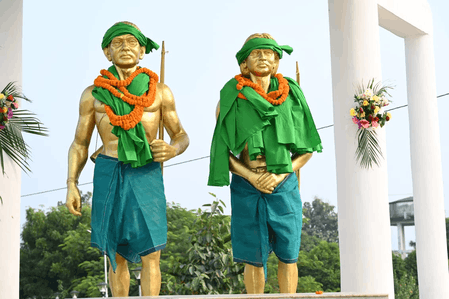
Sahibganj: The historic village of Bhognadih in Jharkhand's Sahibganj district is once again preparing to become the centre of remembrance as thousands gather on June 30 to commemorate the 171st anniversary of the Santhal Hul, one of the most significant tribal uprisings against British colonial rule.
The focal point of the annual observance is the centuries-old banyan tree at Pachkatia, where, on June 30, 1855, tribal leaders Sidhu Murmu, Kanhu Murmu, Chand Murmu, Bairab Murmu, Phulo Murmu and Jhano Murmu gave the call for a mass rebellion against British rule, exploitative moneylenders and the oppressive feudal system.
The uprising began two years before the Revolt of 1857, and many historians and tribal scholars consider it India's first organised freedom movement.
The Jharkhand government will hold a state-level programme at Bhognadih to pay tribute to the martyrs of the Santhal Hul. While Hul Diwas is observed across the state, the birthplace of the rebellion remains its spiritual and historical centre, attracting people from across Jharkhand and neighbouring states.
For the tribal community, Hul Diwas is more than a commemorative event. It symbolises resistance against oppression, celebrates tribal identity and honours the courage of those who sacrificed their lives for justice and self-rule.
Although the 1857 uprising is widely recognised in mainstream history as India's First War of Independence, several scholars argue that the Santhal Hul deserves equal, if not greater, recognition. They maintain that it was a carefully organised mass movement with a clear political objective of ending colonial rule and freeing local communities from exploitation.
Former Director of the Ram Dayal Munda Tribal Research Institute and retired IAS officer Ranendra has noted that the rebellion drew international attention. Political philosopher Karl Marx referred to the Santhal uprising in his writings, including Notes on Indian History, while newspapers in London reported extensively on the fierce resistance mounted by the Santhal people.
Historical records suggest that around 20,000 people assembled at Bhognadih under the leadership of the Murmu siblings before declaring their resolve to challenge British authority. The movement soon spread across the region, drawing participation from Santhals as well as several other indigenous and agrarian communities.
Despite being armed mainly with bows, arrows, axes and other traditional weapons, the rebels mounted a formidable challenge to the East India Company's forces. They inflicted significant casualties during battles at Pirpainti on July 16, 1855, and Birbhum on July 21, 1855.
According to research cited by Jharkhand Encyclopaedia author Sudhir Pal, the rebellion had an impressive organisational structure with dedicated military units, intelligence networks, communication channels and supply systems. The movement also received support from communities including the Paharias, Ahirs, Lohars and others, giving it a broad social base.
Historians estimate that more than 50,000 people from nearly 52 villages took part in the uprising, while over 10,000 lost their lives during the year-long struggle.
The British eventually launched a large-scale military crackdown to suppress the revolt. Chand Murmu and Bairab Murmu were killed in the fighting, while Sidhu Murmu and Kanhu Murmu were captured and executed. Sidhu was hanged from the banyan tree at Pachkatia, which still stands today as a powerful symbol of sacrifice and resistance, while Kanhu was executed in Bhognadih.
Independent India has recognised the contribution of the Santhal heroes through initiatives such as the release of a commemorative postage stamp in honour of Sidhu and Kanhu in 2002. However, many tribal scholars and community leaders believe the Santhal Hul has yet to receive the national recognition it deserves in India's freedom struggle.
As Jharkhand observes the 171st Hul Diwas, Bhognadih will once again echo with tributes to the brave tribal leaders whose fight against colonial rule continues to inspire generations and remains a defining chapter in the history of resistance and social justice.
With inputs from IANS



© Copyright
Reporter Post.All Rights Reserved |
Powered by: Aptilogic Software |
 |
Page rendered in 0.0093 seconds.
|
Page rendered in 0.0093 seconds.