Wed, October 21, 2026


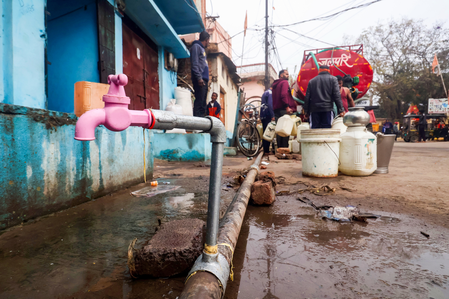
New Delhi: More than 3.5 crore rural households across India still do not have tap water connections, with Kerala and Jharkhand recording the highest share of such homes, the government informed the Lok Sabha on Thursday.
In a written reply, Minister of State for Jal Shakti V. Somanna said that 18.29 per cent of rural households nationwide are yet to receive piped drinking water under the government’s flagship Jal Jeevan Mission.
According to the data, around 45.12 per cent of rural homes in Kerala and 44.82 per cent in Jharkhand are still waiting for tap water connections. In terms of numbers, about 31.93 lakh households in Kerala and 28.03 lakh households in Jharkhand remain without piped water supply.
The minister said that since the launch of the Jal Jeevan Mission in 2019, significant progress has been made in expanding rural water connectivity. At the start of the programme, only 3.23 crore rural households — about 16.7 per cent — had tap water connections.
As of March 3, 2026, more than 12.58 crore additional rural homes have been provided with tap water connections under the “Har Ghar Jal” initiative. This has increased the total coverage to about 15.82 crore households, or 81.71 per cent of the country’s roughly 19.36 crore rural households.
Somanna also informed the House that 11 States and Union Territories have already achieved full coverage under the scheme. These include Gujarat, Haryana, Himachal Pradesh, Punjab, Rajasthan, Tripura, Nagaland, Goa, Dadra and Nagar Haveli and Daman and Diu, Arunachal Pradesh, and the Andaman and Nicobar Islands.
The government said that drinking water supplied under the mission follows the Bureau of Indian Standards’ BIS:10500 guidelines to ensure quality.
States and Union Territories are also allowed to use up to two per cent of their annual Jal Jeevan Mission allocation for water quality monitoring and surveillance. These funds can be used to strengthen testing laboratories, procure equipment, hire skilled staff, conduct community-based water testing, and organise awareness and educational programmes.
To strengthen monitoring mechanisms, the Centre released a “Concise Handbook for Monitoring Water Quality of Piped Drinking Water Supply to Rural Households” in December 2024. The handbook recommends comprehensive testing of drinking water at various stages, including the source, treatment plant, storage points and distribution systems, to ensure safe supply.
According to the ministry, an independent third-party agency periodically assesses the functionality of household tap connections under the mission.
During the 2024 functionality assessment, it was found that 98.1 per cent of surveyed households had tap connections, while 87 per cent reported receiving water in the preceding week. About 84 per cent said water was supplied as per schedule, and 80 per cent were receiving the minimum required supply of 55 litres per capita per day.
The survey also found that 76 per cent of the water supply tested was free from bacteriological contamination and 81 per cent of the water sources were free from chemical contamination. Overall, 76 per cent of the household tap connections assessed were found to be fully functional.
With inputs from IANS



© Copyright
Reporter Post.All Rights Reserved |
Powered by: Aptilogic Software |
 |
Page rendered in 0.0089 seconds.
|
Page rendered in 0.0089 seconds.