Tue, October 20, 2026


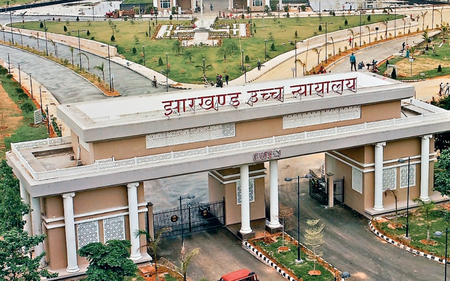
Ranchi: The Jharkhand High Court on Thursday took serious note of worsening air pollution and alleged illegal mining in Dhanbad, questioning the district administration’s response to the situation.
Hearing a public interest litigation (PIL), a division bench headed by Chief Justice M.S. Sonak directed several key officials to appear before the court in person on April 2. Those summoned include the Deputy Commissioner and Senior Superintendent of Police of Dhanbad, the Member Secretary of the Jharkhand State Pollution Control Board, and the Municipal Commissioner.
The court also asked the Chairman-cum-Managing Director of Bharat Coking Coal Limited (BCCL) to attend the hearing and present suggestions on measures that could help reduce pollution in the coal mining region.
During the proceedings, the bench expressed deep concern over the deteriorating air quality in Dhanbad. It pointed out that reports of widespread illegal coal mining and transportation were aggravating the environmental crisis.
The judges questioned the role of the police, observing that there appeared to be little visible action to prevent illegal mining activities.
According to the court, the growing concentration of coal dust has severely affected air quality in the district, posing a major health threat to residents. Respiratory illnesses and other pollution-related diseases were highlighted as key concerns.
Advocate Amit Kumar Das, appearing for BCCL, informed the court that the company has been attempting to improve environmental conditions by converting abandoned open-cast mines into parks.
BCCL also stated that it had registered several FIRs against illegal mining but alleged that police action on these complaints had been inadequate.
The company has filed a separate petition related to the issue, which the court has now ordered to be heard along with the main PIL filed by the Rural Unity Forum.
Earlier, the court had asked the District Mining Officer to submit details of steps taken to control illegal mining. However, the state government’s affidavit merely claimed that pollution levels were under control without providing concrete information about enforcement measures.
The petitioner, Rural Unity Forum, argued that both the district administration and the Dhanbad Municipal Corporation had failed to take effective steps to address the pollution problem. It alleged that most anti-pollution measures exist only on paper and have not produced any real change on the ground.
BCCL, however, maintained that coal transportation is carried out with proper covering, along with regular water sprinkling and monitoring to control dust.
The court appeared unconvinced by these assurances and signalled that senior officials would be held directly responsible for tackling the growing pollution crisis in Dhanbad.
With inputs from IANS




© Copyright
Reporter Post.All Rights Reserved |
Powered by: Aptilogic Software |
 |
Page rendered in 0.0095 seconds.
|
Page rendered in 0.0095 seconds.