Wed, July 15, 2026

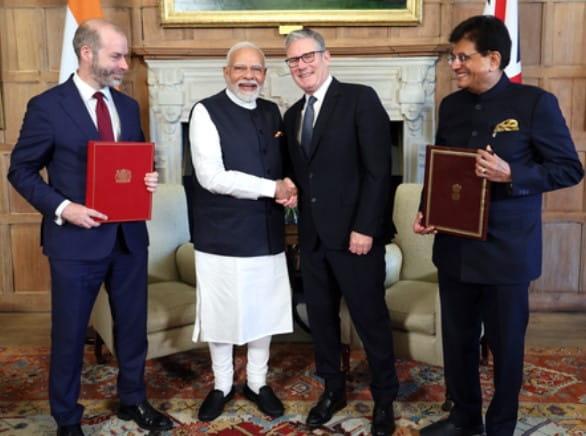
New Delhi: The India-UK Comprehensive Economic and Trade Agreement (CETA) will come into effect on July 15, marking a major milestone in bilateral trade by making several British products more affordable in India while giving Indian exporters almost complete duty-free access to the UK market.
With the agreement taking effect, import duties on a range of British products, including Scotch whisky, gin, chocolates, biscuits and cosmetics, will begin to decline. While some tariff reductions will be immediate, others will be implemented in phases over the coming years.
For India, the agreement offers a significant boost to exports, with around 99 per cent of tariff lines receiving zero-duty access to the UK. This covers nearly the entire value of India's exports to Britain and is expected to improve the competitiveness of Indian products.
Labour-intensive industries such as textiles, leather, footwear, marine products, gems and jewellery, sports goods and toys are likely to benefit the most. Engineering products, auto components and organic chemicals are also expected to gain from easier access to the UK market.
The Central Board of Indirect Taxes and Customs (CBIC) has issued the necessary rules outlining how goods will qualify for preferential tariff treatment under the agreement and the compliance requirements for exporters and importers.
Union Commerce and Industry Minister Piyush Goyal said the agreement would strengthen cooperation between India and the UK in trade, investment and innovation while opening up fresh opportunities for businesses and professionals. He encouraged Indian companies to build stronger partnerships with their British counterparts and leverage the agreement for long-term growth.
Earlier, the minister had described the trade pact as a landmark agreement that would benefit farmers, fishermen, artisans, micro, small and medium enterprises (MSMEs), startups, women entrepreneurs and young professionals by expanding access to the premium UK market. He also said Indian consumers would benefit from greater availability of high-quality imported products at competitive prices.
The agreement, signed on July 24, 2025, after 14 rounds of negotiations, covers 30 chapters dealing with trade in goods and services, digital commerce, financial services, intellectual property, innovation, sustainability and government procurement.
As part of the pact, India will reduce or eliminate tariffs on 90 per cent of tariff lines, with 85 per cent becoming completely duty-free over the next 10 years. Import duties on British Scotch whisky will be reduced from 150 per cent to 75 per cent initially and further lowered to 40 per cent over a decade. Tariffs on British automobiles will also be reduced gradually under a quota-based system.
The agreement also includes a Double Contributions Convention, allowing eligible Indian professionals temporarily working in the UK to avoid paying social security contributions in both countries for a specified period, reducing their financial burden while on overseas assignments.
With inputs from IANS




| 14-09-2018 | ||||||
| Sl No. | Parameters | Actual Data(µg/m3) | Standard Limit(µg/m3) |
|---|---|---|---|
| 1 | PM 10 | 64 | 100 |
| 2 | PM 2.5 | 33 | 60 |
| 3 | SO2 | 55.3 | 80 |
| 4 | NO2 | 58.2 | 80 |
| 14-09-2018 | ||||||
| Station | Temperature(degree centigrade) | Rainfall(mm) | Relative humidity(%) | |||
|---|---|---|---|---|---|---|
| Max | Min | Past 24 hrs. | Since 1st March, 2018 | Max | Min | |
| Ranchi | 31.0 | 22.5 | 000.0 | 1010.1 | 95 | 66 |
| Jamshedpur | 34.1 | 26.2 | 000.0 | 1252.8 | 87 | 58 |
| Bokaro | 33.5 | 24.6 | 015.2 | 824.0 | 92 | 79 |
| Daltonganj | 32.6 | 24.9 | 004.2 | 960.9 | 95 | 67 |
© Copyright
Reporter Post.All Rights Reserved |
Powered by: Aptilogic Software |
 |
Page rendered in 0.0671 seconds.
|
Page rendered in 0.0671 seconds.