Fri, July 10, 2026

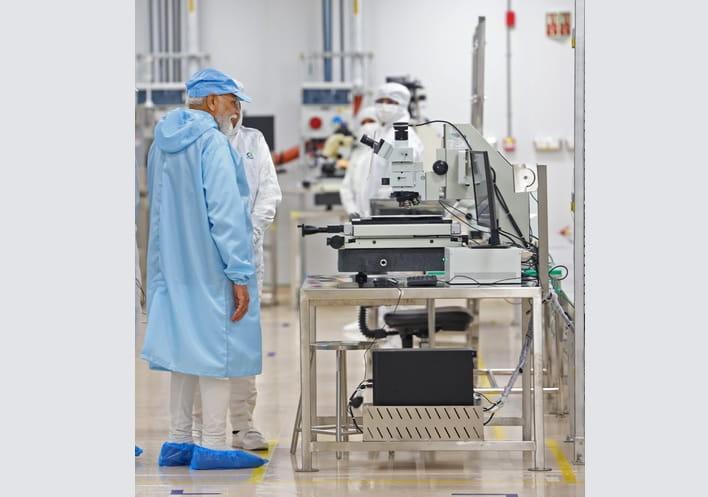
New Delhi: Industry leaders have welcomed the Central government's decision to rationalise customs duties on key capital equipment and critical components used in electronics manufacturing, saying the move will encourage higher domestic value addition, attract fresh investments and strengthen India's manufacturing ecosystem.
The government has reduced customs duties on important inputs used in the production of lithium-ion battery cells, display assemblies and wireless charging inductor coil modules.
India Electronics and Semiconductor Association (IESA) President Ashok Chandak described the decision as a strategic step that goes well beyond a routine customs duty revision.
According to Chandak, the measure will reduce capital costs for manufacturers, improve the financial viability of new projects and encourage investments across the electronics supply chain. He said it would also help India move from an assembly-driven manufacturing model to becoming a globally competitive electronics production hub.
He noted that the latest policy complements flagship initiatives such as the Electronics Component Manufacturing Scheme (ECMS) and the Semicon India Programme, both aimed at strengthening the country's electronics and semiconductor ecosystem.
Chandak added that the growing domestic production of smartphones, electric vehicles, telecom equipment, medical devices and energy storage systems is steadily increasing demand for semiconductors. Building a strong ecosystem for electronic components today, he said, will lay the foundation for a robust semiconductor industry in the future.
Indian Cellular and Electronics Association (ICEA) Chairman Pankaj Mohindroo also welcomed the government's decision, particularly the expansion of customs duty benefits for display assemblies used in automotive, medical and industrial applications.
He said the move would help develop manufacturing ecosystems in these specialised sectors, similar to the rapid growth witnessed in mobile phone and consumer electronics display assembly in recent years.
Industry estimates suggest that India's electronics market is expected to exceed 400 billion US dollars by 2030, while the country's semiconductor demand could cross 103 billion US dollars during the same period.
At the same time, India is rapidly building a large-scale lithium-ion battery manufacturing ecosystem to support the expansion of electric mobility and energy storage. Industry experts believe that lower duties on manufacturing equipment will make these investments more competitive while enhancing the resilience of the country's electronics supply chain.
With inputs from IANS




| 14-09-2018 | ||||||
| Sl No. | Parameters | Actual Data(µg/m3) | Standard Limit(µg/m3) |
|---|---|---|---|
| 1 | PM 10 | 64 | 100 |
| 2 | PM 2.5 | 33 | 60 |
| 3 | SO2 | 55.3 | 80 |
| 4 | NO2 | 58.2 | 80 |
| 14-09-2018 | ||||||
| Station | Temperature(degree centigrade) | Rainfall(mm) | Relative humidity(%) | |||
|---|---|---|---|---|---|---|
| Max | Min | Past 24 hrs. | Since 1st March, 2018 | Max | Min | |
| Ranchi | 31.0 | 22.5 | 000.0 | 1010.1 | 95 | 66 |
| Jamshedpur | 34.1 | 26.2 | 000.0 | 1252.8 | 87 | 58 |
| Bokaro | 33.5 | 24.6 | 015.2 | 824.0 | 92 | 79 |
| Daltonganj | 32.6 | 24.9 | 004.2 | 960.9 | 95 | 67 |
© Copyright
Reporter Post.All Rights Reserved |
Powered by: Aptilogic Software |
 |
Page rendered in 0.2111 seconds.
|
Page rendered in 0.2111 seconds.