Tue, October 27, 2026
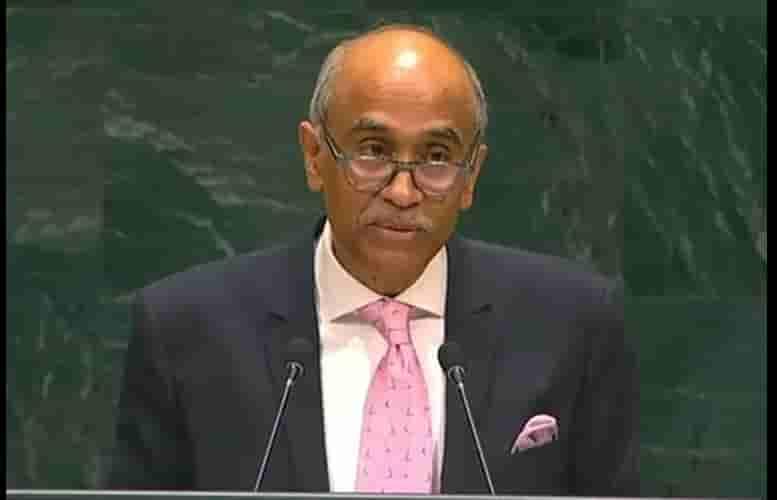
Photo: IANS
India has criticised what it described as a “disguised, de facto veto” obstructing efforts to reform the United Nations Security Council (UNSC), arguing that the insistence on consensus has prevented negotiations from making meaningful progress.
Addressing a General Assembly debate on Monday on the veto powers of the five permanent Security Council members, India's Permanent Representative to the UN, P. Harish, said the Intergovernmental Negotiations (IGN) process on Security Council reforms had been stalled by procedural objections from some countries.
“The argument of consensus has been harnessed as a disguised, de facto veto in the IGN process as well,” Harish said.
He pointed to the role of the Uniting for Consensus group, led by Italy and including Pakistan, which has opposed the adoption of a negotiating text in the reform process.
Harish said a 2008 General Assembly resolution that established the foundation for the IGN process specified “the widest possible political acceptance” as the guiding principle, rather than consensus. Despite 17 rounds of negotiations, he said, the process had failed to produce a concrete outcome because of what India considers an unwritten veto over procedural decisions.
India believes the next step should be the early commencement of text-based negotiations, supported by clearly defined timelines and milestones, to move the reform process forward.
Harish also drew attention to informal vetoes within the Security Council, arguing that the problem extends beyond the formal veto exercised by the five permanent members — China, France, Russia, the United Kingdom and the United States.
He said the unwritten practice of consensus allows any Council member, whether elected or permanent, to block or delay presidential statements, press statements and decisions of sanctions committees, often without providing an explanation.
“The veto is not only what is cast in the open. There is also the ‘effective or de facto veto’ that every Council member, elected and non-elected, holds over presidential statements, press statements and the decisions of sanctions committees,” he said.
India has repeatedly raised concerns over the blocking of proposed UN sanctions against individuals accused of terrorism. Harish cited cases involving Pakistan-based figures, including Zaki-ur-Rehman Lakhvi and Shahid Mahmood of Lashkar-e-Taiba, as well as Sajid Mir and Masood Azhar of Jaish-e-Mohammed. China has previously blocked or delayed proposals concerning several such individuals through the Security Council's sanctions procedures.
Arguing that changes to the use of veto powers alone would not resolve the Council's structural shortcomings, Harish called for comprehensive reform, including an expansion of permanent membership.
“The questions of credibility, legitimacy and efficacy that hang over the Security Council will not be answered by managing the veto alone,” he said.
He added that the Council's composition must reflect contemporary geopolitical realities rather than the global power structure that emerged from the Second World War eight decades ago.
India has also maintained that countries granted permanent membership under a reformed Council should enjoy the same veto rights as existing permanent members.
“We reiterate that as long as the veto exists, it must be held by all permanent members of a reformed Council,” Harish said, arguing that fairness and justice require equal treatment.
He rejected proposals to create additional categories of membership, such as countries with longer terms but no permanent status, or permanent members without veto powers. According to Harish, such arrangements would create a new hierarchy among members and risk preserving the inequalities that reform is intended to address.
Harish also expressed scepticism about the General Assembly mechanism requiring countries to explain their use of the veto in the Security Council. Although the initiative was intended to improve accountability and encourage change, he said the continued use of vetoes since its introduction had produced results contrary to those expectations.
India's intervention underscores its push for a broader restructuring of the Security Council, with changes to both its membership and decision-making procedures. However, the competing positions of UN member states over representation, veto powers and the rules governing negotiations continue to complicate efforts to reach an agreement.


© Copyright
Reporter Post.All Rights Reserved |
Powered by: Aptilogic Software |
 |
Page rendered in 0.0126 seconds.