Fri, September 25, 2026

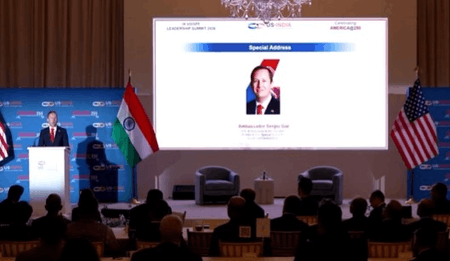
Washington- Senior officials from India and the United States expressed confidence that a long-awaited bilateral trade agreement is close to completion, while highlighting growing cooperation in artificial intelligence (AI), semiconductors, defence manufacturing and resilient supply chains.
The optimism was evident at the US-India Strategic Partnership Forum (USISPF) Leadership Summit, where government officials, lawmakers and business leaders said the India-US relationship is entering a new phase driven by technology, investment and shared strategic interests.
Sergio Gor, the US Ambassador to India, said negotiations on the bilateral trade agreement have reached the final stage.
"Most of this deal is complete," Gor said. "There's a few items that remain from both sides, but it's in the last one or 2 per cent of that deal."
He added that both governments have been working on the agreement for nearly 18 months and described it as a "win-win" outcome for both nations.
Rejecting speculation about any weakening in bilateral ties, Gor said cooperation in trade, defence and people-to-people exchanges remains robust. He also announced that the foreign ministers of the Quadrilateral Security Dialogue (Quad) are expected to meet in the Philippines in the coming weeks. According to him, the US Embassy in New Delhi has facilitated $20.5 billion in fresh investments into the United States this year.
India's Ambassador to the United States, Vinay Mohan Kwatra, said India's economic transformation has made it "an indispensable anchor" of global growth, stability and trusted partnerships.
Kwatra said continued economic reforms, expanding manufacturing and investments in advanced technologies have positioned India to become a $7 trillion economy by the end of the decade.
He identified biotechnology, AI, semiconductors and quantum technologies as key areas for future India-US collaboration, adding that achieving the goal of $500 billion in bilateral trade by 2030 would require deeper integration of supply chains, investment, manufacturing and skilled talent.
Competition with China in advanced technology also emerged as a major theme during the summit.
Jacob Helberg described India as America's most important long-term partner in building trusted technology ecosystems, saying it is "the only country on earth that fundamentally rivals China" in engineering talent.
He said Washington aims to diversify critical technology supply chains beyond China while working with India to develop a shared AI developer ecosystem.
In his opening address, Mukesh Aghi, President of the USISPF, said many American companies are steadily reducing their dependence on China while expanding manufacturing and research operations in India.
The summit also highlighted bipartisan political support in Washington for stronger ties with New Delhi.
Steve Daines said India and the US together possess the scale needed to match China in innovation, while Mark Warner described India as one of America's top long-term strategic partners.
Ro Khanna said the partnership should continue to be built on shared democratic values alongside expanding defence and economic cooperation.
Former US Ambassador Kenneth Juster said strong people-to-people connections have been the foundation of India-US relations for decades. He also unveiled the USISPF commemorative coffee table book, We the People: 250 Voices that Have Shaped the US-India Relationship.
Speakers at the summit agreed that the India-US partnership has evolved well beyond its traditional focus on diplomacy and defence, with technology, manufacturing, supply chain resilience, energy security and investment now shaping the next phase of bilateral cooperation.
With inputs from IANS



© Copyright
Reporter Post.All Rights Reserved |
Powered by: Aptilogic Software |
 |
Page rendered in 0.008 seconds.
|
Page rendered in 0.008 seconds.